Timișoara is a city repairing itself before your eyes. The 2023 European Capital of Culture year took the Iosefin water tower, the Fabric synagogue and the Neptun baths off the list of ruins, and the construction sites keep going. That is exactly why the abandoned places still left in and around Timișoara are precious: you explore them now, or you find them a few years from now turned into museums. For this article we picked three abandoned buildings that genuinely exist in 2026: the oldest tobacco factory in Romania, a mausoleum that copies the Esztergom basilica and a water tower that literally belongs to nobody. Our map lists 56 geolocated abandoned places in Timiș county, and the ones below are a starting point, not the full inventory.
Urbex Maps gathers over 233,000 geolocated spots in more than 200 countries, including over 1,100 abandoned places in Romania. Every place below comes with its dated history, a video, a spot card with an “Add to my map” button and exact GPS coordinates, free, no credit card needed. If you want the big picture of the country, start with the top abandoned places in Romania, then move on to the other cities: Bucharest, Cluj-Napoca, Iași and Constanța.
Urbex in Timișoara: why Urbex Maps changes the game
Many “free” urbex sites end up selling you the exact address through a forum or a subscription. We do the opposite: you hit “Add to my map” and the exact GPS coordinates are saved for free in your personal space, no credit card required. Since 2021, a community of over 40,000 explorers has been checking every coordinate at least twice before publication. The three places below are ranked by visual impact and historical weight, each with its link to the map of abandoned places in Romania. You can open them all from the free urbex map or from my map. One principle: we never encourage breaking in, and the rule is always “take only photos, leave only footprints”.
The 3 abandoned places around Timișoara at a glance
| Place | County/Area | Type | Access 2026 |
|---|---|---|---|
| Fabrica de Țigarete (Cigarette Factory) | Timișoara | Tobacco factory (1846) | Off-limits, fenced private land |
| Csávossy Mausoleum | Bobda, Cenei commune (Timiș) | Mausoleum turned church | Open ruin, access tolerated |
| Fabric water tower | Timișoara, Fabric district | Water tower (1912-1914) | Exterior free, interior closed |
1. Fabrica de Țigarete: the oldest tobacco factory in Romania
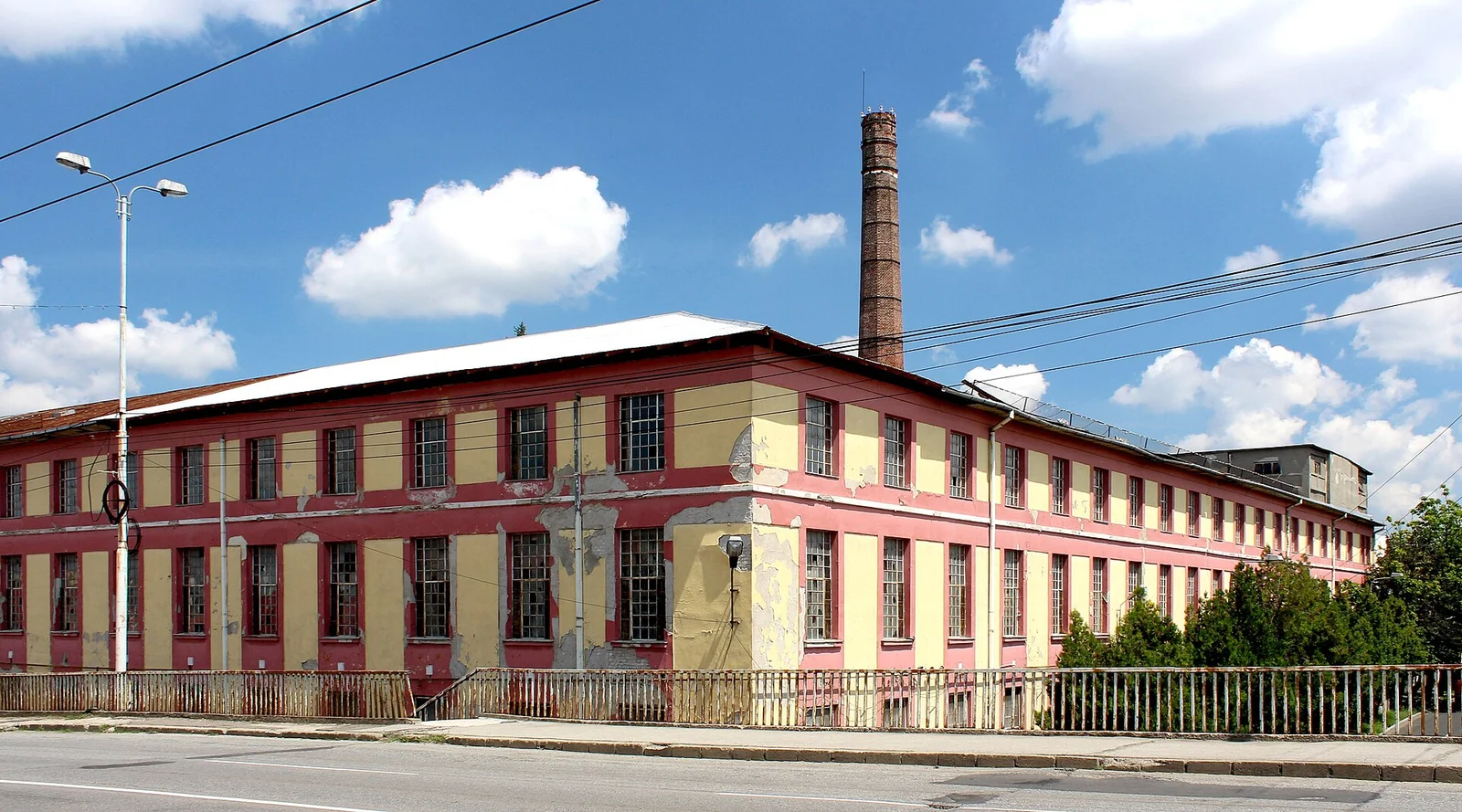
Founded in 1846, the Fabrica de Țigarete (Cigarette Factory) in Timișoara is the oldest tobacco factory on the territory of present-day Romania and was the second in the entire Habsburg Empire, after the one in Fiume. Around 1900, some 2,000 women workers rolled 200 million cigarettes a year here, and the factory was one of the city’s biggest employers. Production stopped in 2003, and since then the 26,380 m² of brick halls and pavilions, a historic monument on Romania’s heritage register, have been quietly rotting away. The owner has been insolvent since 2016, so nobody pays even for minimal upkeep, and in January 2025 the city hall only repaired the neighbouring bridge, not the factory. The land is private and fenced off, so there is no legal way inside: settle for the facades, which tell half the story anyway, and keep an eye on the insolvency case for the day the gates open. The rest of the county is waiting for you on the map of abandoned places in Timiș.
2. The Csávossy Mausoleum in Bobda: the Esztergom basilica, in miniature and in ruins
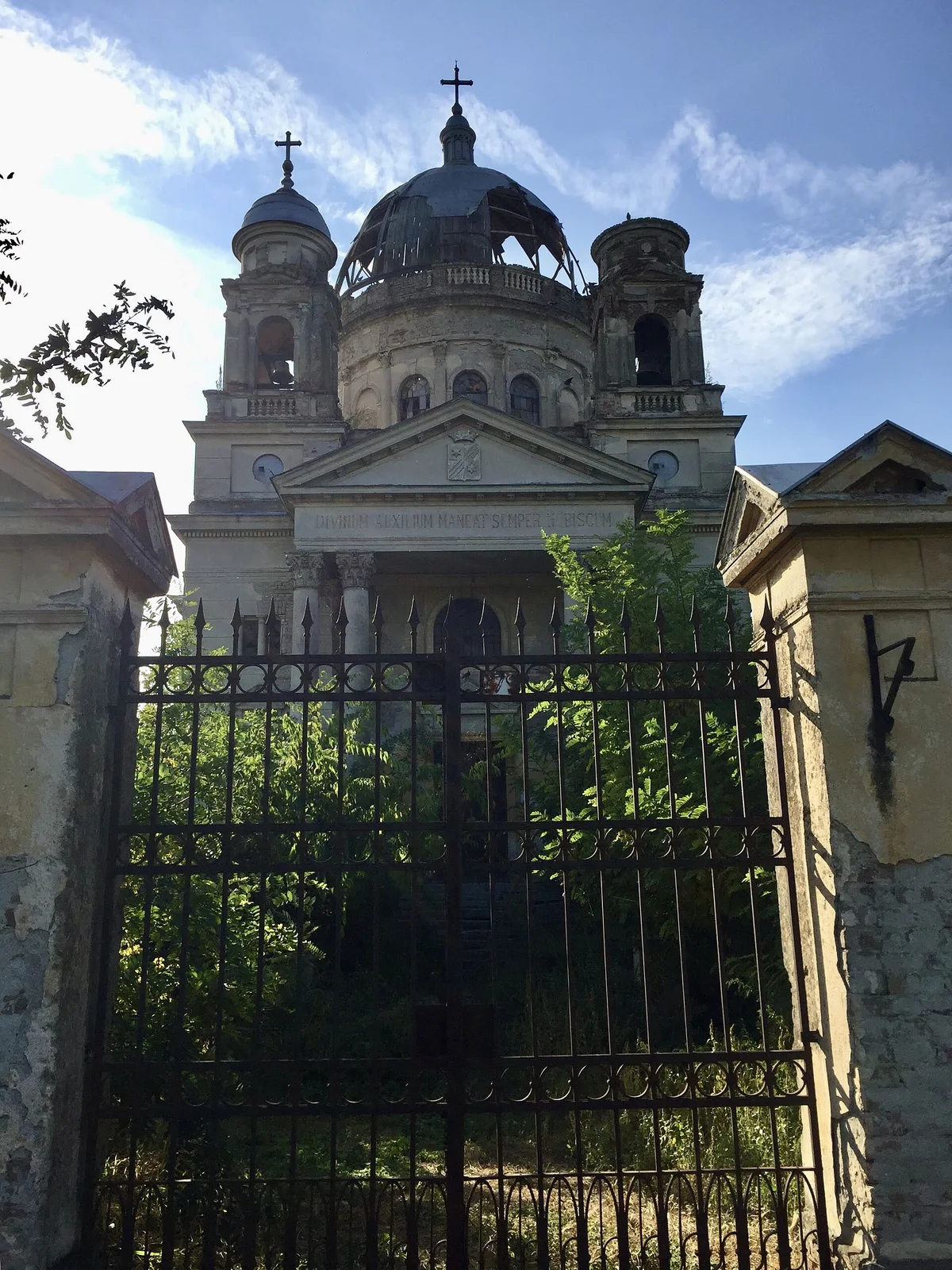
Some 22 km west of Timișoara, in the village of Bobda in Cenei commune, Baron Gyula Csávossy built himself, in the second half of the 19th century, between 1860 and 1880, a family mausoleum designed as a miniature replica of the Esztergom basilica, Hungary’s largest church. The building later served as a parish church, but it was abandoned after 1940 and systematically looted: crypts broken open, ornaments torn off, lead and iron carted away for scrap. Locals call it “the cursed church” (biserica blestemată), and if haunted places are your thing, the legend here comes bundled with very real decay: the right tower fell in the 2010s, the dome collapsed in 2020, and the bells, strangely, still ring. In November 2025 the Timiș County Council took over the monument, but for now it has only launched the restoration paperwork, estimated at 36 months, so the ruin remains explorable in its raw state. This is a burial site: enter with respect, do not touch the crypts and take nothing. The area has its own page on the map of abandoned places in Cenei.
3. The Fabric water tower: the monument nobody owns
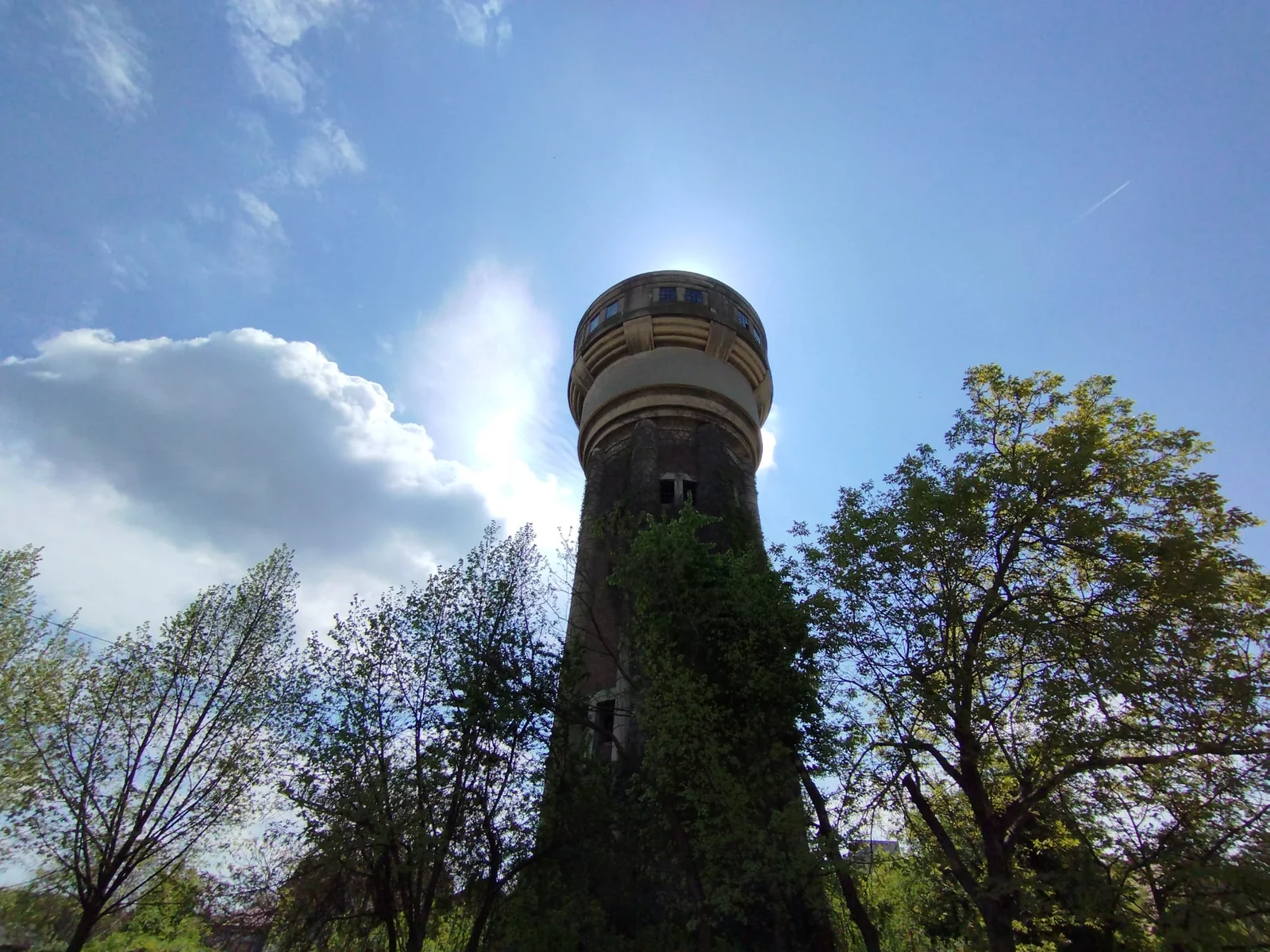
Built between 1912 and 1914 by the contractors Lenarduzzi & Sabathiel, the Fabric water tower stands 52 metres tall and carried a 500 m³ reservoir at its top, part of Timișoara’s first modern water supply system. Its windows have been gone for decades, pigeons have claimed the upper floors, and its legal status is an administrative tragicomedy: the monument literally became “nobody’s”, after the ownership papers were lost in the 2017 bankruptcy of the “1 Iunie” factory. The city hall has been trying since 2023 to bring it back into municipal ownership, but in 2026 there is no construction site in sight. The contrast is the city’s urban-planning lesson: the twin tower in Iosefin was restored with millions and reopens in 2025-2026, while its brother in Fabric rots a few kilometres away. The exterior can be photographed freely from the street, the interior is closed and dangerous, so do not force the doors. You will also find the tower on the map of Romania’s great ruins, alongside the rest of the national top.
Abandoned places in Timișoara: frequently asked questions
What is left to explore in Timișoara after the 2023 Capital of Culture year?
Less than five years ago, and that is good news for the city. TM2023 sped up the renovations: the Iosefin water tower, the synagogue in the Fabric district and the Neptun baths were pulled out of decay. Timișoara’s stock of abandoned buildings shrinks year after year, so the remaining places, the cigarette factory, the Fabric tower or the Bobda mausoleum, are worth documenting now, while they still exist in their raw state.
What is the most famous abandoned place around Timișoara?
In the city itself, the Fabrica de Țigarete: it is the oldest tobacco factory in Romania and anyone walking past its fence sees it. When it comes to international fame, though, the winner is the Csávossy mausoleum in Bobda, filmed by urbex channels with millions of subscribers and part of local folklore as “the cursed church”.
Is urbex legal in Romania?
There is no law dedicated to urban exploration. Looking and taking photos from public space is perfectly legal. Entering fenced private land, like the cigarette factory, is trespassing, and breaking a lock or a fence is breaking and entering, which we never encourage. At open ruins like Bobda, access is tolerated in practice, but you remain at your own risk. The golden rule: take only photos, leave only footprints, and if you are asked to leave, you leave.
How do you get the GPS coordinates of these places?
Every place in this article has a spot card with an “Add to my map” button. One click and the exact GPS coordinates are saved for free to your personal map, no credit card needed. Then you open them all in the free urbex map and build your route through Timiș, area by area.
Is the trip to Solventul Margina worth it?
Yes, if you have a full day to spare. The former Solventul chemical plant in Margina is about 82 km east of Timișoara on the DN68A, and it remains one of the most spectacular industrial ruins in western Romania: huge halls, towers and rust-eaten installations. It is the kind of site that perfectly rounds off an urbex weekend starting from the city.
Is the Uszoda pool in Fabric still an urbex spot?
In the short term, it no longer counts as a target: from August 2026 a volunteer work camp starts there to secure the old swimming pool. It is exactly the happy scenario we keep talking about, an abandoned place that leaves the list because someone is saving it, not because it collapsed.
What is happening to the old slaughterhouse in Timișoara?
Since 2025 the former slaughterhouse complex has an approved zoning plan (PUZ) for the land controlled by the Țiriac group, so the direction is real-estate conversion. The first bulldozers are still a long way off, but the exploration window is closing: if you want to document the brick halls in their current state, do not put it off forever.
Explore the map of abandoned places in Romania
The three places above tell, on a small scale, the story of all of post-1989 Romania: deindustrialisation that left entire factories without a purpose, restitutions and lost paperwork that block any renovation for years, emptying villages and scrap-metal thieves finishing what time started. Timișoara has the advantage of repairing itself faster than the rest of the country, so urbex here is a race against the clock. On the map of abandoned places in Romania, over 1,100 geolocated spots are waiting for you, from the Banat to Moldavia. Save your favourites to my map, hit the road and explore with respect for the places and for your own safety.