
Urbex in Rennes has a reputation for being thin ground, and that is partly true: the historic centre has few raw wastelands, and several places the forums still cite are in fact demolished or repurposed. But the moment you widen the radius to Ille-et-Vilaine, the scenery changes: a 1908 foundry frozen in rust at Servon-sur-Vilaine, a 1919 industrial water tower left abandoned in the Baud plain, private chateaux swallowed by vegetation west of the city. On our map, dozens of geolocated spots cover the department and the whole of Brittany.
For this article we picked 3 places that are genuinely abandoned and still standing in 2026, each verified one by one: an industrial foundry counted among Brittany's best-known urbex sites, a water tower whose abandonment local press still confirmed in 2025, and the Chateau de la Janais, an 1893 manor left abandoned at Le Rheu, west of Rennes. No demolished spots, no renovated site passed off as a ruin. Under each entry, an "Add to my map" button saves the GPS coordinates to your personal account, for free and with no credit card.
The queries urbex Rennes, Rennes urbex map, abandoned places Rennes, urbex spot Rennes, urbex around Rennes and urban exploration Ille-et-Vilaine all point to the same reality: an industrial and aristocratic heritage that history set aside - foundry crises, factories moving out of the centre, chateaux too costly to maintain - and that photographers, urbexers and historians are rediscovering today. This guide gives you each site's dated history, its legal status and its real dangers, before handing you its coordinates.
Free Rennes urbex: why Urbex Maps changes the game
Before the spots, a word on what makes this guide different. Most sites that talk about free urbex in Rennes put "free" in the title, then redirect you to a paid forum or a closed Telegram group. Here the promise is concrete: under each place, an "Add to my map" button sends the GPS coordinates to your personal account, with no subscription and no credit card.
Behind the map is a community of more than 40,000 explorers, active since 2021. Every coordinate is checked at least twice - by the contributor who submits it, then by a regional moderator who confirms the spot still exists and has not been walled up. The places offered in this article are part of that catalogue; the rest of the Breton spots are unlocked through packs that fund the moderation and field verification.
One reminder before you set off: urbex is not illegal in itself, but entering private property without permission is trespassing (article 226-4 of the French Penal Code, up to one year in prison and a 15,000 euro fine). We document these places for their history; we never encourage breaking in. Helmet, torch, ankle boots and caution on the floors: these industrial wastelands and abandoned chateaux carry real collapse risks.
1. The Servon-sur-Vilaine foundry - the open-air museum of rust (35)

About twenty kilometres east of Rennes, the former Servon-sur-Vilaine foundry is one of the best-known urbex spots in Ille-et-Vilaine. Founded in 1908 by Charles Brisou, ideally placed near the railway line and a body of water, by the 1920s it ranked among the most important industrial works in the department. The shipbuilding crisis hit it hard: from 400 employees in 1977, the workforce collapsed the following year. The site eventually closed and remains frozen as it was - furnaces, machinery and coal left in place. Source: Brittany heritage inventory.
It is the archetype of the photogenic industrial wasteland: vast halls, corroded metal frames, lime furnaces, rust-covered machines and nature slowly reclaiming the ground where cast iron was still being poured a few decades ago. The site is large and, rare for the genre, relatively spared by graffiti, with superb plays of light that make it a renowned playground for photographers. It perfectly illustrates our approach: when a city centre does not have five genuine ruins, we widen the radius rather than sell you a renovated site.
The site is private property: access is not authorised without the owner's agreement. The main risks of a foundry abandoned for decades: corroded floors and metal walkways, holes in the ground, unstable frames, shards of glass and scrap metal underfoot. Ankle boots, a helmet and a torch are essential. Access from Servon-sur-Vilaine, about twenty minutes by car from central Rennes via the N157.
The Servon foundry remains the most iconic urbex spot in the Rennes ring: the best entry point to understand Ille-et-Vilaine's industrial past.
2. The Baud-Chardonnet water tower - the forgotten tower of the Baud plain (Rennes)
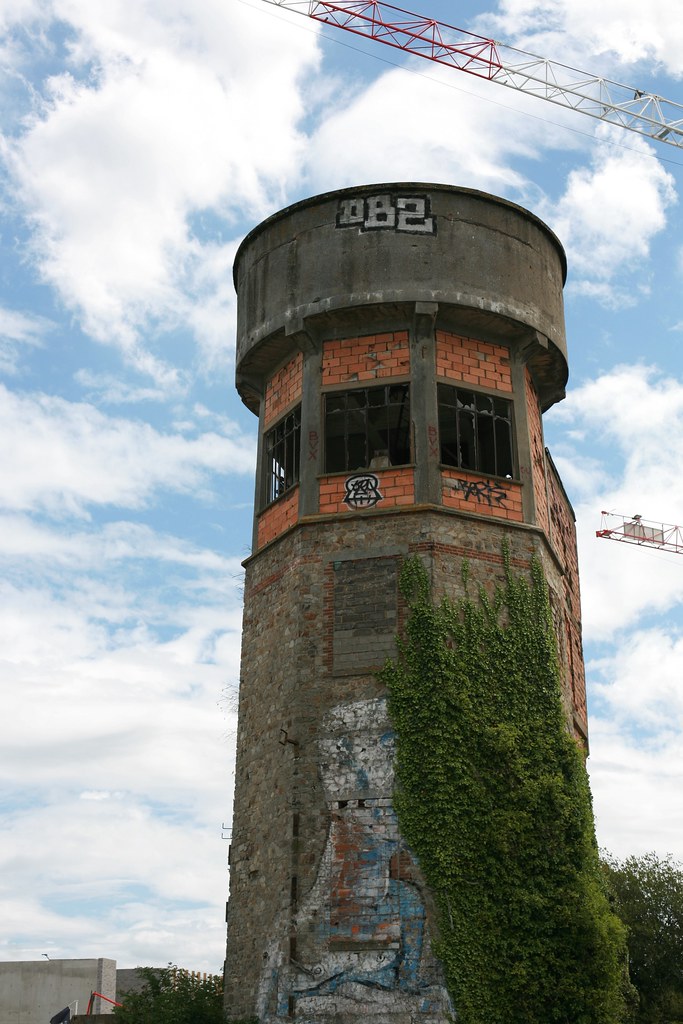
In the Baud plain, 2 km east of central Rennes, stands a curious concrete tower: the former Baud-Chardonnet water tower. Built in 1919 and around 23 metres tall, the building first served as a water tower and later as a grain silo - a direct relic of the industrial past of a sector packed with factories until the 1980s. Long abandoned, it is now surrounded by the new Baud-Chardonnet residential district that has grown up all around it.
An important point to know - in 2025, local press (L'Essentiel Rennes) confirmed the water tower is still abandoned, and that a project to convert it into a community space and biodiversity refuge is under study, with no fixed timeline. So it is more a spot to observe and photograph from the outside than a place to enter: the tower is closed, and its interior (the tank, the metal stairs) is dangerous. Set in the heart of a residential district, ten minutes from the centre by bus, it is one of the most accessible abandoned backdrops in central Rennes.
Baud-Chardonnet is the textbook "see it before it changes" spot: until the conversion begins, the tower remains a raw witness to Rennes' industry.
3. Chateau de la Janais - the abandoned manor of Le Rheu (west of Rennes)

About ten kilometres west of Rennes, on the edge of the Lorient road (RN24), at Le Rheu, stands the Chateau de la Janais. Built in 1893 by Emile Jean Martin, a Rennes brush manufacturer, on the remains of the old manor of la Jaunais, it is an eclectic house of brick and schist, recognisable by its round pepperpot-roofed turret and its square corner tower bearing the letter "M". Later bought by Citroen and turned into a workers' hostel, it was eventually left to abandonment. With no Historic Monument protection, it is now degrading without a safety net - local press was still raising the alarm in 2025.
La Janais is the archetype of the frozen bourgeois house: brick facades reclaimed by ivy, a pepperpot turret, enfilades of empty rooms and warping woodwork. Visible to all from the dual carriageway, the chateau has watched over the western gateway to Rennes for more than a century and remains one of the most recognisable spots in the area. It perfectly illustrates our approach: when a city centre lacks genuine ruins, we widen the radius into the ring rather than sell you a renovated site.
Private property: the interior is not accessible without permission, and trespassing is still punishable under article 226-4 of the French Penal Code. Unmaintained and without heritage protection, the building carries the standard risks - unstable floors, falling stone, a weakened roof structure. We document it for its history, without encouraging break-ins; it is best observed from the road. Le Rheu is about fifteen minutes from central Rennes via the RN24.
La Janais sums up the spirit of urbex around Rennes: you have to leave the city, towards the western ring, to find the finest abandoned houses - but this time with a real name and a real history.
FAQ - Urbex Rennes
Is urbex legal in Rennes?
Urban exploration is not illegal in itself, but entering private property without permission is trespassing (article 226-4 of the French Penal Code). Most Rennes spots are private: we document them for their history, without ever encouraging break-ins. For more, read our guide is urbex legal in France.
Where can I find other abandoned places around Rennes?
Our map lists dozens of spots across Ille-et-Vilaine and the rest of Brittany. You can add the three places in this article to your personal map for free via the button under each entry, then unlock the rest through our regional packs.
Why only 3 spots for Rennes?
Because we prefer honesty to filler. Central Rennes has few raw wastelands still standing, and several places the forums cite are in fact demolished (the arsenal, largely) or repurposed (the Jacques-Cartier prison, being converted with guided tours). So we kept three places that are genuinely abandoned and verified in 2026, even if it meant widening the radius to the department. See also our Lyon urbex guide to compare approaches.
Do I need special gear to explore the Servon foundry?
For an industrial wasteland like the Servon foundry, ankle boots, a helmet and a torch are essential: corroded metal walkways, scrap metal and glass underfoot are the main dangers. Our urbex gear guide covers the essentials to start safely.
Conclusion: Rennes, a city to explore by widening the circle
From the Servon foundry to the water tower of the Baud plain and the Chateau de la Janais at Le Rheu, Rennes urbex tells a century of history: the golden age of Breton industry, the slow deindustrialisation of the metro area and the fate of chateaux too costly to maintain. These places are not stage sets: they are open-air history books, fragile, to be explored with respect and without damage. Add them to your map, and carry on your exploration with our Lyon urbex guide or the free urbex map.