Urbex in Lyon has a distinctive face: a city built on two hills, ringed by 19th-century military forts and connected by kilometres of tunnels. Between the abandoned casemates of Fort de Loyasse on the Fourviere hill, the chateaux left to the vegetation in the Ain, and the industrial wastelands of the chemical valley, Lyon's urban exploration scene is a dense playground. On our map, thousands of geolocated spots cover the Rhone and the whole Auvergne-Rhone-Alpes region.
For this article we picked 4 places that are genuinely abandoned and still standing in 2026, each verified one by one: a fort of the Lyon defensive belt, a chateau in the Ain frozen for half a century, a 1930s radio transmitter listed as a Historic Monument, and the forgotten sanatoriums of the Hauteville plateau. No demolished spots, no renovated site passed off as a ruin. Under each entry, an "Add to my map" button saves the GPS coordinates to your personal account, for free and with no credit card.
The queries urbex Lyon, Lyon urbex map, abandoned places Lyon, urbex spot Lyon, urbex around Lyon and urban exploration Rhone all point to the same reality: a military, aristocratic and industrial heritage that history set aside - military withdrawals, bankruptcies, rural exodus, health laws - and that photographers, urbexers and historians are rediscovering today. This guide gives you each site's dated history, its legal status and its real dangers, before handing you its coordinates.
Free Lyon urbex: why Urbex Maps changes the game
Before the spots, a word on what makes this guide different. Most sites that talk about free urbex in Lyon put "free" in the title, then redirect you to a paid forum or a closed Telegram group. Here the promise is concrete: under each place, an "Add to my map" button sends the GPS coordinates to your personal account, with no subscription and no credit card.
Behind the map is a community of more than 40,000 explorers, active since 2021. Every coordinate is checked at least twice - by the contributor who submits it, then by a regional moderator who confirms the spot still exists and has not been walled up. The places offered in this article are part of that catalogue; the rest of the thousands of French spots are unlocked through packs that fund the moderation and field verification.
One reminder before you set off: urbex is not illegal in itself, but entering private property without permission is trespassing (article 226-4 of the French Penal Code, up to one year in prison and a 15,000 euro fine). We document these places for their history; we never encourage breaking in. Helmet, torch, ankle boots and caution on the floors: half of the spots below carry real collapse risks.
1. Fort de Loyasse - the forgotten fort of Fourviere (Lyon 9th)

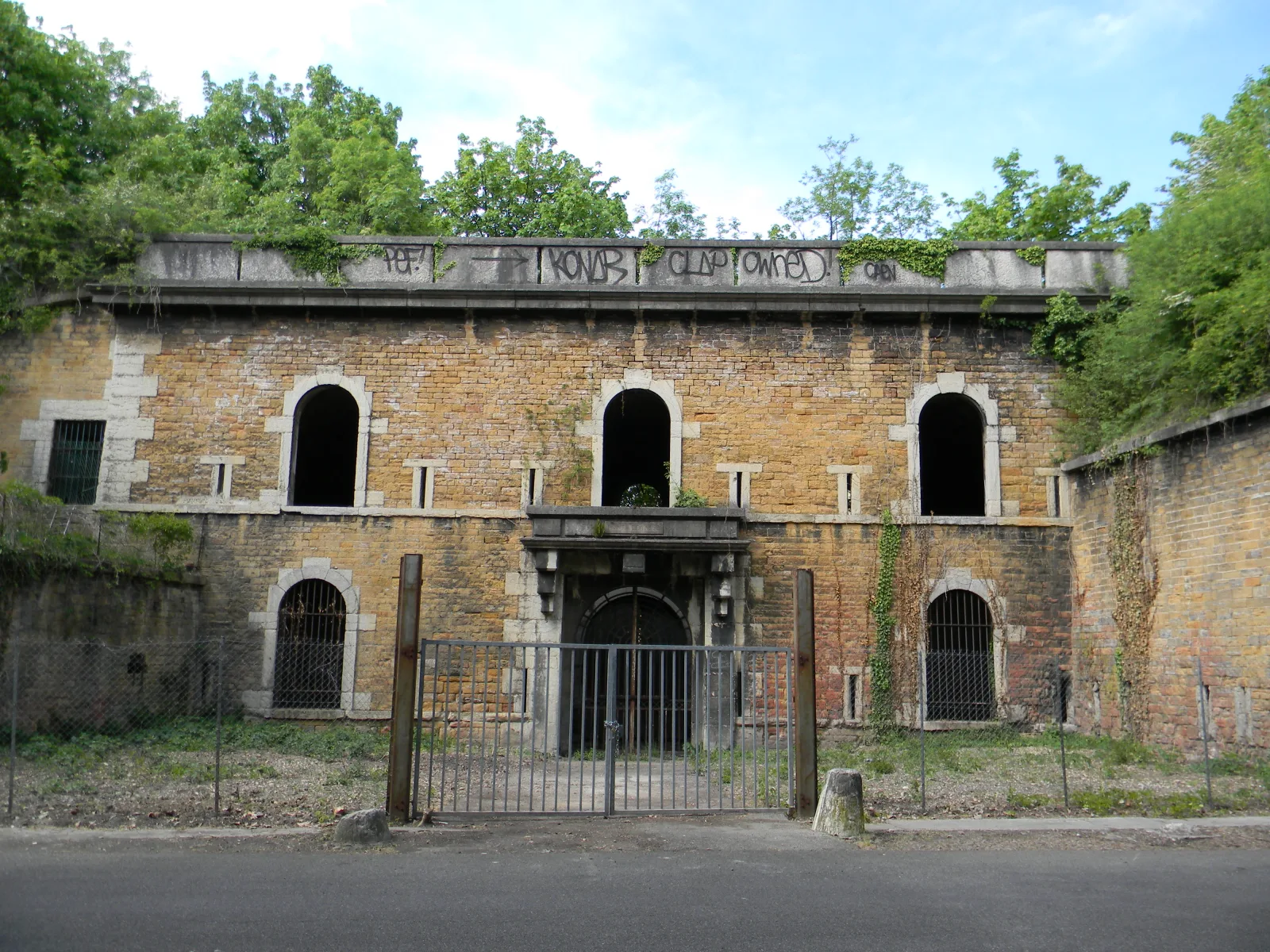
Built between 1836 and 1840 in the famous golden stone of the Lyonnais, Fort de Loyasse belongs to the first fortified belt of Lyon, raised after the July Revolution out of fear of an Austrian invasion. The fort served as a prisoner depot during the First World War, then was occupied by the Germans from 1939 to 1945. Decommissioned in 1920 and left to decay since the 1950s, it now belongs to the City of Lyon, which uses only part of it (allotment gardens) - the rest, barracks and tunnels, is crumbling.
The underground galleries, a former mushroom farm repurposed after the military left, run beneath the entire hill and are the spot's main draw. Above ground you'll find the vaulted casemates, the inner courtyard overrun by vegetation and the intact golden-stone facade. In August 2025 the outlet Rue89 Lyon still ran a report on the fort's depths, proof the place is still being explored.
The site is closed to the public and owned by the City: access is not authorised. The tunnels are dangerous - a 15-year-old was seriously injured in July 2023 after falling in a gallery. Main risks: holes in the floors, narrow unsecured descents, total darkness. A powerful head torch, a helmet and company are essential. Access via the Montee de l'Observance (Lyon 9th), ten minutes from the Vaise district.
Fort de Loyasse remains the most iconic urbex spot in central Lyon: the best entry point to understand the city's military belt.
2. Chateau de Montbriand - the manor frozen for 50 years (Messimy-sur-Saone, Ain)
About forty kilometres north of Lyon, in Messimy-sur-Saone (Ain), the Chateau de Montbriand is a 17th-century manor, listed as a Historic Monument in 1989. Never restored, abandoned for nearly half a century, it is the archetypal forgotten chateau: cracked facades, sagging parquet, stone fireplaces and staircases slowly reclaimed by vegetation. It is a good example of widening the radius into the departments bordering the Rhone, where chateau urbex is far richer than in the city centre.
Private property: the interior is not accessible without permission. An important point to know - a property-restoration scheme (ORI) was launched in late 2024 (public inquiry in December 2024), which means the chateau could eventually be renovated and leave the urbex world. Until works begin, the manor remains abandoned. Standard risks of an old, unmaintained building: unstable floors, falling stone, weakened roof structure.
Montbriand is probably the best-documented abandoned chateau in the Lyon ring: one to see before restoration closes it.
3. The Radio-Lyon transmitter - the concrete temple of Dardilly
In Dardilly, west of Lyon, stands a curious concrete building shaped like a temple: the former Radio-Lyon transmitter. Radio-Lyon, one of France's first private stations, was founded in 1927; its Dardilly transmitter was built in 1935 by architect Gabriel Devereux, topped by a 135-metre antenna mast. Damaged by the Germans in 1944, the site operated until 1952, then was abandoned. The mast is gone, but the building - facades, roofs, pool and gate bearing the "Radio Lyon" lettering - survives and was listed as a Historic Monument in 1990.
The building is fenced off and privately owned: it is more a spot to observe and photograph from the outside than a place to enter. Its Art Deco architecture and monumental lettering still make it one of the most photogenic abandoned backdrops in the metro area. Worth watching: since 2025 the Chambrun foundation, which owns it, has been studying a cultural conversion of the site that could eventually reopen it to the public. About ten kilometres from central Lyon, reachable by car via the D307.
4. The Hauteville plateau sanatoriums - the town that healed (Ain)
For anyone willing to drive an hour east of Lyon, the Hauteville plateau (Ain) is one of the largest abandoned sanatorium complexes in France. The resort was created in the early 20th century by Felix Mangini and Doctor Frederic Dumarest to treat tuberculosis; the Dumarest sanatorium took in its first patients in late 1912. With the end of tuberculosis, these vast buildings closed one after another: the Belligneux pavilion has been abandoned since 2000 (its Art Deco stained glass was rediscovered in 2021), and the Esperance sanatorium closed in 2024. Source: Wikipedia.
Be careful: not every pavilion is intact - the Bellecombe building was demolished in 2022. These are private or hospital properties, abandoned but watched in places, with serious risks (asbestos typical of old medical buildings, floors, lift shafts). Hauteville perfectly illustrates our approach: when a city does not have five genuine spots at its core, we widen the radius rather than sell you renovated sites. Find every spot in the area on the Ain map.
FAQ - Urbex Lyon
Is urbex legal in Lyon?
Urban exploration is not illegal in itself, but entering private property without permission is trespassing (article 226-4 of the French Penal Code). Most Lyon spots are private or owned by the City: we document them for their history, without ever encouraging break-ins. For more, read our guide is urbex legal in France.
Where can I find other abandoned places around Lyon?
Our map lists thousands of spots across the Rhone and neighbouring departments (Ain, Isere, Loire). You can add the four places in this article to your personal map for free via the button under each entry, then unlock the rest through our regional packs.
Do I need special gear to explore the Lyon forts?
For the Fort de Loyasse tunnels, a powerful head torch is essential, along with a helmet and ankle boots. For the Hauteville sanatoriums, an FFP3 mask is recommended because of the asbestos. Our urbex gear guide covers the essentials to start safely.
Can I visit Fort de Loyasse legally?
The fort is closed to the public and access is not authorised. Some Lyon heritage associations occasionally run tours of other forts in the belt (Bron, Vancia). For Loyasse, no official visit exists to date: it is a spot to discover with the utmost caution and full awareness of the legal risks.
Conclusion: Lyon, a city to explore above and below ground
From the Fourviere hill to the plateaux of the Ain, Lyon urbex tells two centuries of history: the fear of invasion that bristled the city with forts, the golden age of radio, the splendour of the Saone valley chateaux and the fight against tuberculosis. These places are not stage sets: they are open-air history books, fragile, to be explored with respect and without damage. Add them to your map, and carry on your exploration with our top 10 abandoned places in Auvergne or the free urbex map.