Urbex in Montpellier is an exercise in honesty. The city is young, in the middle of a building boom, and most of the wastelands in the centre have already been demolished or renovated: the former Grasset maternity hospital has become the Cite des Arts, the Chateau Bon is being turned into luxury flats for 2026, and several historic spots have been knocked down. To find genuine abandoned places near Montpellier, you have to widen the radius into the Herault, from the Montagnac vineyards to the Somail forests. On our map, geolocated spots cover the whole of the Herault and the Occitanie region.
We won't lie to you: Montpellier is a city that is poor in pure urbex spots. Rather than padding a list with renovated or demolished sites, we chose to give you 3 places that are genuinely abandoned and still standing in 2026, each verified one by one: an 18th-century folly left to itself by the metropolis, the abandoned "Little Versailles" of Montagnac, and a former sanatorium lost in the Somail forest. No phantom spots, no invented ruins. Under each entry, an "Add to my map" button saves the GPS coordinates to your personal account, for free and with no credit card.
The queries urbex Montpellier, Montpellier urbex map, abandoned places Montpellier, urbex spot Montpellier, urbex around Montpellier and urban exploration Herault all point to the same reality: an aristocratic, festive and rural heritage that history set aside, and that photographers, urbexers and the curious are rediscovering today. This guide gives you each site's dated history, its legal status and its real dangers, before handing you its coordinates.
Free Montpellier urbex: why Urbex Maps changes the game
Before the spots, a word on what makes this guide different. Most sites that talk about free urbex in Montpellier put "free" in the title, then redirect you to a paid forum or a closed Telegram group. Here the promise is concrete: under each place, an "Add to my map" button sends the GPS coordinates to your personal account, with no subscription and no credit card.
Behind the map is a community of more than 40,000 explorers, active since 2021. Every coordinate is checked at least twice: by the contributor who submits it, then by a regional moderator who confirms the spot still exists and has not been walled up. The places offered in this article are part of that catalogue; the rest of the thousands of French spots are unlocked through packs that fund the moderation and field verification.
One reminder before you set off: urbex is not illegal in itself, but entering private property without permission is trespassing (article 226-4 of the French Penal Code, up to one year in prison and a 15,000 euro fine). We document these places for their history; we never encourage breaking in. Helmet, torch, ankle boots and caution on the floors: these old buildings carry real collapse risks.
1. Chateau de la Mosson: the folly forgotten by the metropolis (Celleneuve)

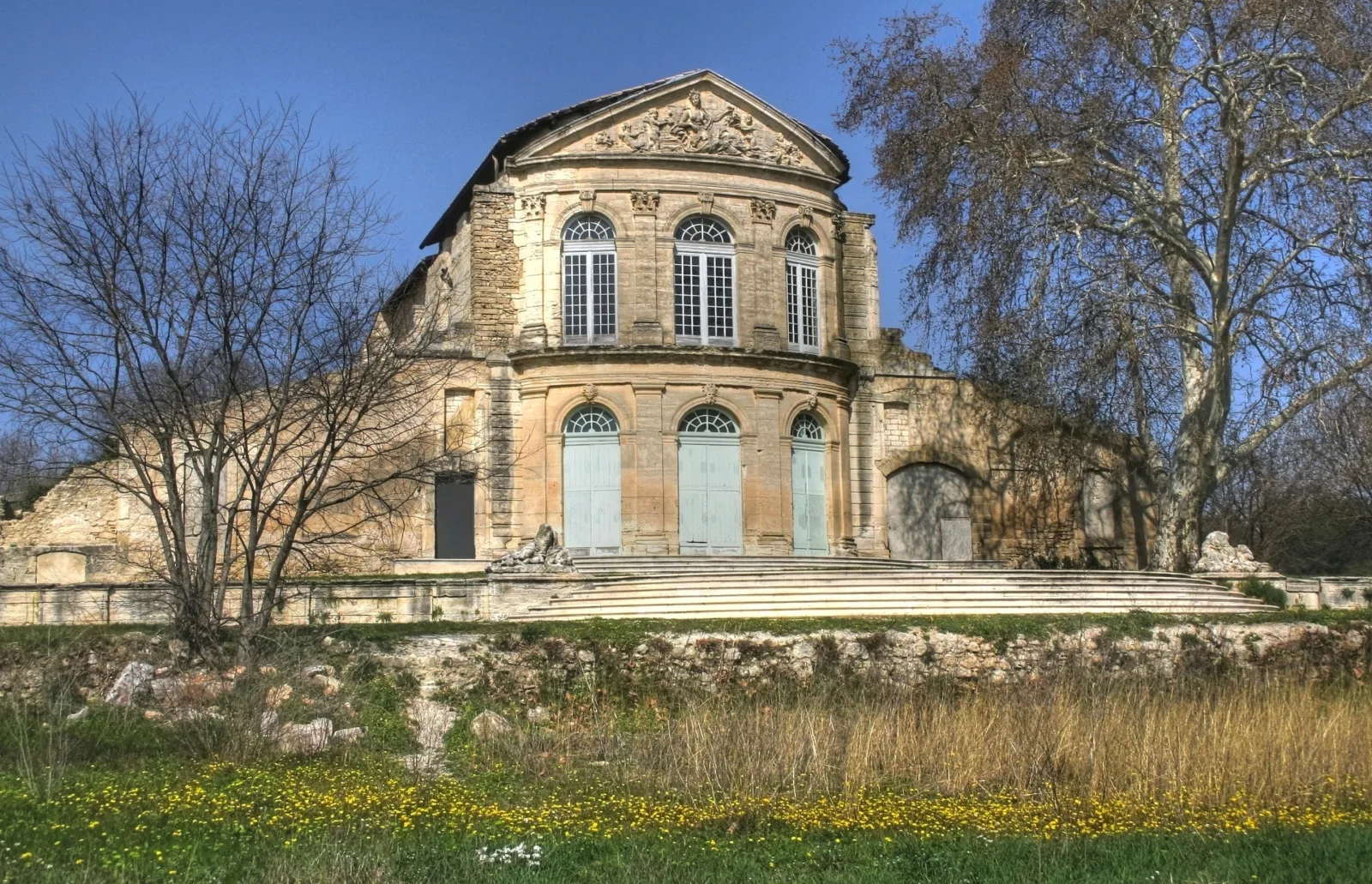
Built between 1723 and 1729 by Joseph Bonnier, treasurer of the States of Languedoc, the Chateau de la Mosson is one of the most lavish "Montpellier follies", the pleasure houses that the robe nobility had built around the city. At the height of its glory it housed a cabinet of curiosities famous across Europe. Sold and dismantled as early as the 18th century, it now belongs to the metropolis of Montpellier, which has left it abandoned for years for lack of a funded rehabilitation project. The estate is listed as a Historic Monument, but its facades, pools and nymphaeum are decaying in the open air.
The appeal of the place is the contrast: sumptuous classical architecture, galleries and a monumental water feature, all surrendered to the vegetation. It is the archetype of forgotten heritage in the heart of a city, ten minutes from central Montpellier in the Celleneuve district, on the edge of Juvignac, beside the Mosson river.
An important point to know: since 2017 part of the estate has been used as a travellers' reception site, and the place is closed to the public except for occasional guided tours (Heritage Days). Access is therefore not open and remains sensitive: it is more a place to observe and photograph from the outside than a spot to enter. Standard risks of an old, unmaintained building: unstable floors, falling stone, weakened roof structures. Respect the occupants and the metropolis's property.
La Mosson remains the most spectacular abandoned backdrop in central Montpellier: one to see while no rehabilitation has yet closed it off.
2. Chateau de Lavagnac - the forgotten "Little Versailles" of Montagnac

About forty kilometres west of Montpellier, in Montagnac, the Chateau de Lavagnac is nicknamed the "Little Versailles of Languedoc". Built in the 17th and 18th centuries on a site occupied since the Middle Ages, this vast classical chateau is a listed Historic Monument (inscribed in 1951, classified in 1973). Bought in 1987 for the Japanese billionaire Hideki Yokoi, it stopped being maintained and slid into abandonment. Since 2006 a string of speculative property schemes - up to 663 homes, a five-star hotel and a golf course - have all failed: the golf project was rejected by the prefect of the Herault in May 2023, then deemed incomplete by the environmental authority in October 2024.
The estate is the archetype of the grand classical chateau left to itself: balustraded facades, enfilades of empty rooms, stone staircases and a park gone wild. It is one of the most spectacular and best-documented abandoned chateaux in the Herault, prized by photographers for its scale and its air of faded splendour.
Private property owned by a property company: access is not authorised. Unmaintained for decades, the building carries the standard risks - collapsed floors, falling stone, weakened roof structures. Note: a redevelopment project remains dormant and the site's status may change, so check before any visit. About forty minutes from Montpellier via the A750 then Montagnac.
Lavagnac is the benchmark abandoned chateau around Montpellier: one to see while the property schemes have not yet closed it off.
3. The Somail sanatorium - the hospital lost in the forest (Saint-Pons-de-Thomieres)

Deep in the Somail forest, on the heights above Saint-Pons-de-Thomieres, at the far western edge of the Herault, hides a former tuberculosis sanatorium from the early 20th century, later converted into a children's asthma centre and then an open-air cure home. The establishment, long a treatment place for children, closed for good in 1995. A rehabilitation project launched in 2011-2012 was dropped, weighed down by cost and the presence of asbestos. Since then the large concrete building, isolated in the forest, has sunk into abandonment.
Deserted corridors, rooms with shattered windows, arcaded facades eaten by moss: the sanatorium has the typical - and sought-after - atmosphere of these forgotten hospitals. Its forest isolation heightens the mood. Recent explorations, in late 2025, confirm it is still standing and abandoned, even if its condition worsens year by year.
Abandoned private property: access is not authorised. Two specific dangers apply here - the likely presence of asbestos (the very reason the rehabilitation project was dropped) and badly damaged floors at risk of giving way. An FFP3 mask, a torch and ankle boots are essential. The site is isolated in the Somail forest, west of the Herault, more than an hour from Montpellier. Find every spot in the area on the Herault map.
This sanatorium is the most authentic spot in this selection for lovers of abandoned hospitals: a genuine piece of medical history frozen in the forest.
FAQ: Urbex Montpellier
Is urbex legal in Montpellier?
Urban exploration is not illegal in itself, but entering private property without permission is trespassing (article 226-4 of the French Penal Code). Most Montpellier spots are private or owned by the metropolis: we document them for their history, without ever encouraging break-ins. For more, read our guide is urbex legal in France.
Are there really abandoned places in Montpellier?
Few in the very centre, and that is a reality we own up to: Montpellier is a young, fast-growing city where many wastelands have been demolished or renovated. The real spots are found by widening the radius into the Herault (Montagnac, the Somail, the back country). That is exactly the approach of this guide: three solid places rather than a list padded with invented ruins.
Do I need special equipment for these places?
Yes, especially for the Somail sanatorium: an FFP3 mask is essential there (likely asbestos), along with a head torch, a helmet and ankle boots for the damaged floors. For the Mosson and Lavagnac chateaux, watch out for unstable floors and falling stone. Our urbex gear guide covers the essentials to start safely.
Where can I find other abandoned places around Montpellier?
Our map lists spots across the Herault and Occitanie. You can add the three places in this article to your personal map for free via the button under each entry, then unlock the rest through our regional packs. Our urbex gear guide will help you set off well equipped.
Conclusion: Montpellier, a city to explore around rather than at its centre
Montpellier is not an easy urbex land, and we would rather tell you so frankly than sell you a dream. But between the forgotten folly of la Mosson, the abandoned "Little Versailles" of Lavagnac and the lost sanatorium of the Somail, the Herault tells three very real stories of abandonment. These places are not stage sets: they are fragile fragments of history, to be explored with respect and without damage. Add them to your map, and carry on your exploration with our guide urbex in Lyon or the free urbex map.