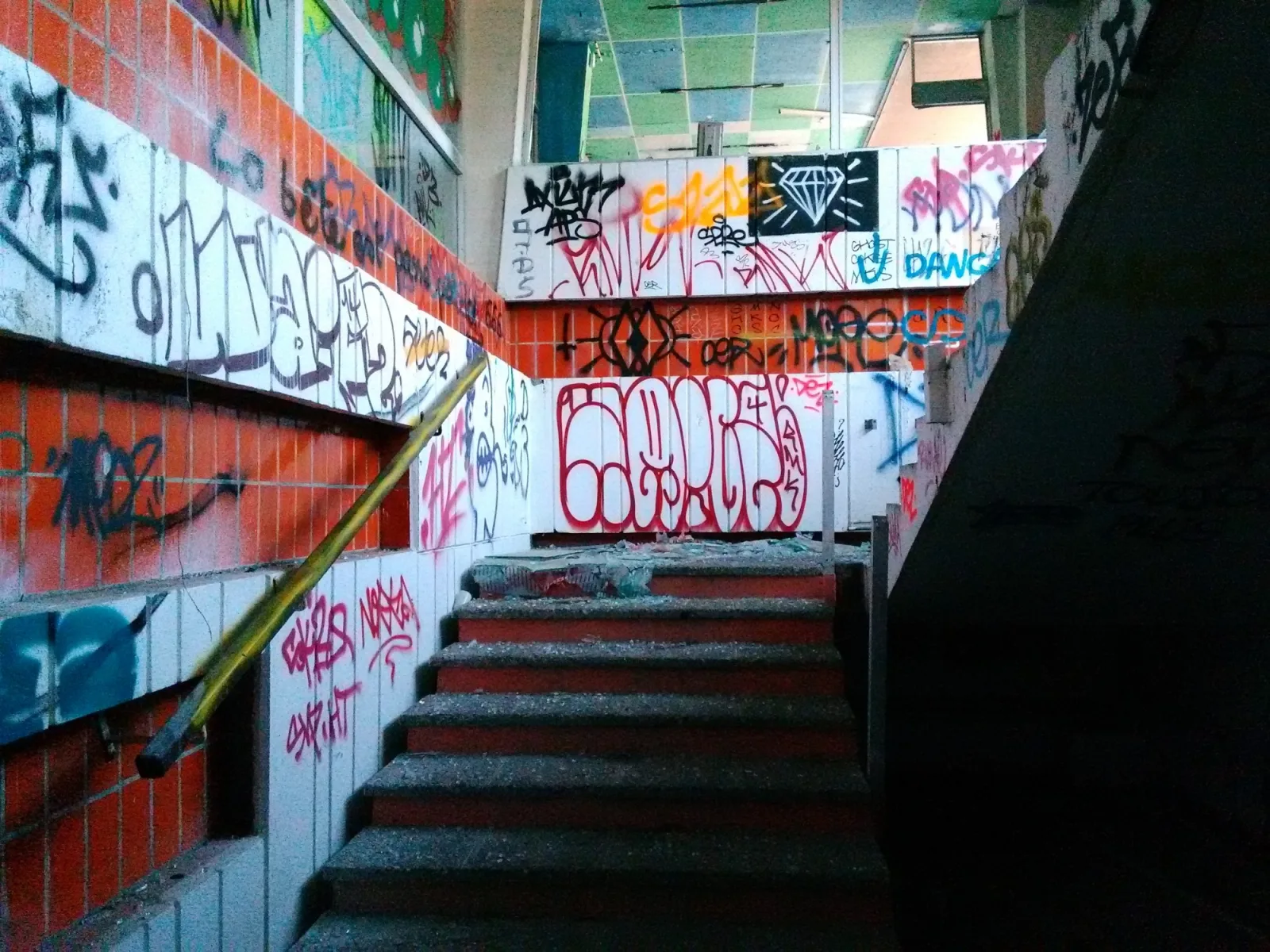
Urbex in Marseille has a face of its own: a city wedged between the sea and the calanques, bristling with forts and military batteries and dotted with industrial wastelands left by two centuries of port chemistry. Between the Luminy swimming pool handed over to taggers since 2008, the forgotten bunkers of the Frioul islands and the acid factories eaten away by pollution, Marseille's urban exploration scene is a dense and radically different playground. On our map, hundreds of geolocated spots cover the Bouches-du-Rhone and the whole Provence-Alpes-Cote d'Azur region.
For this article we picked 4 places that are genuinely abandoned and still standing in 2026, each verified one by one: an Olympic pool closed for fifteen years, the remains of the world's first underwater cable car, the German batteries of a fortress island, and one of the most polluted chemical factories in France. No demolished spots, no renovated site passed off as a ruin, no tragedy turned into an attraction. Under each entry, an "Add to my map" button saves the GPS coordinates to your personal account, for free and with no credit card.
The queries urbex Marseille, Marseille urbex map, abandoned places Marseille, urbex spot Marseille, urbex around Marseille and urban exploration Bouches-du-Rhone all point to the same reality: a military, sporting and industrial heritage that history set aside, bankruptcies, pollution scandals, buried projects, and that photographers, urbexers and historians are rediscovering today. This guide gives you each site's dated history, its legal status and its real dangers, before handing you its coordinates.
Free Marseille urbex: why Urbex Maps changes the game
Before the spots, a word on what makes this guide different. Most sites that talk about free urbex in Marseille put "free" in the title, then redirect you to a paid forum or a closed Telegram group. Here the promise is concrete: under each place, an "Add to my map" button sends the GPS coordinates to your personal account, with no subscription and no credit card.
Behind the map is a community of more than 40,000 explorers, active since 2021. Every coordinate is checked at least twice, by the contributor who submits it, then by a regional moderator who confirms the spot still exists and has not been walled up. The places offered in this article are part of that catalogue; the rest of the thousands of French spots are unlocked through packs that fund the moderation and field verification.
One reminder before you set off: urbex is not illegal in itself, but entering private property without permission is trespassing (article 226-4 of the French Penal Code, up to one year in prison and a 15,000 euro fine). We document these places for their history; we never encourage breaking in. In Marseille more than anywhere, two extra dangers apply: the chemical pollution of some wastelands and the weakened floors of abandoned buildings. Helmet, torch, ankle boots and a mask are the baseline.
1. Luminy pool - the Olympic pool left to the taggers (Marseille 9th)

Inaugurated in February 1973 by mayor Gaston Defferre, the Luminy pool is a sports complex set at the gates of the Calanques national park, with its fifty-metre Olympic basin and diving board. Closed in 2008 for asbestos removal, it never reopened: the reopening announced for 2013 was abandoned and the facility slowly slipped into oblivion. Over some fifteen years the place became a brutalist set devoured by graffiti, one of the best-known abandoned swimming pools in France.
The large empty basin, the concrete stands, the diving board and the basement changing rooms form a photogenic whole that has become an open-air street-art gallery. The contrast between the 1970s architecture and the vegetation reclaiming the site fascinates explorers. Be aware: in March 2021 the City and the Clean My Calanques association ran a major clean-up there and removed more than 3,500 tyres, a sign of the dumping ground the site had sunk into.
The site is closed, owned by the City and fenced off: access is not authorised. An important point to know - in 2023 the city announced the construction, by 2027, of new aquatic complexes to replace the North and Luminy pools, for around 80 million euros. The Luminy pool is therefore living on borrowed time: until works begin, it remains standing and abandoned. Standard risks: slippery floors, broken glass, decayed concrete structures. A torch, closed shoes and caution are essential. Access via Rue Henri Cochet, in the 9th, near the Luminy campus.
The Luminy pool remains the most iconic urbex spot in central Marseille: one to see before demolition erases it for good.
2. The Callelongue telescaphe - the remains of the underwater cable car (Marseille)
At the end of the road to Les Goudes, at the entrance to the Callelongue cove, lie the rusted remains of one of the wildest inventions in Marseille's history: the telescaphe, the world's first underwater cable car. Dreamed up by former ski champion James Couttet and engineer Denis Creissels, it was inaugurated on 26 June 1967: four bell-shaped glass cabins carried visitors ten metres deep over five hundred metres, between Callelongue and Cap Croisette. Despite nearly 30,000 curious passengers, the attraction closed at the end of the 1967 season, sunk by unsustainable maintenance costs.
All that survives of the underwater dream are the four large wheels of the departure station, fully oxidised, around which the cables once wound. You can spot them beneath the orientation table facing Maire island, at the entrance to the cove. It is an open-air spot, more industrial memory than building exploration, but one of the most singular relics on the Marseille coast: a technological failure frozen in metal and salt.
The remains are in open access, within the Calanques national park, at the far end of the Callelongue hamlet (the end of the road to Les Goudes). It is the simplest spot in this selection on the legal side: you observe and photograph, without damaging anything, in strict respect of the park's rules (no fire, no collecting). Take care on the slippery seaside rocks.
3. The Frioul batteries - the forgotten fortress island (Frioul islands, Marseille)
About twenty minutes by ferry from the Old Port, the Frioul archipelago lines up two centuries of abandoned fortifications. The forts of Pomegues and Ratonneau, built in the late 19th century, were supplemented in 1943-1944 by the Sudwall, the Mediterranean equivalent of the Atlantic Wall: the Germans occupied the islands from October 1943 to August 1944 and built batteries, trenches and bunkers there. The Cap Caveau battery, nicknamed the "German village", still holds in an old shelter a fresco painted by a soldier in 1944. After the bombardments of the Liberation, these works were quickly abandoned. Source: Calanques national park.
Vaulted casemates, gun emplacements, underground galleries, trenches and barracks are scattered across the plateaus of Pomegues and Ratonneau. The highlight remains the tropical fresco of Cap Caveau, a beach, palm trees and sailboats painted by a gunner nostalgic for the colonies, still legible despite the sea spray. Closed to the public from 2015 to 2023 for risk of collapse, the battery has been partly secured and can now be walked.
The islands are freely accessible by ferry from the Old Port, but some works remain dangerous and signposted: holes, unprotected drops, dark casemates. Stay on the secured paths, bring a head torch for the shelters, and respect the park's protected wildlife (gull nesting area). It is one of the largest abandoned military complexes open to the public around Marseille.
4. The Legre-Mante factory - the chemical wasteland of the Calanques (Madrague de Montredon, Marseille)
In the Madrague de Montredon, at the gates of the Calanques, the former Legre-Mante factory is a textbook case: a vast industrial site of about ten buildings, long the world's leading producer of tartaric acid. The activity, born in the 19th century, ceased in 2009 for lack of profitability, leaving behind a severely polluted site contaminated with lead, arsenic and cadmium. Property-redevelopment projects have followed one another since 2017, but the permits have been annulled by the courts and, in December 2024, the State was ordered to decontaminate the sites before 2028. In 2026 the wasteland is therefore still standing, frozen by litigation.
Warning, a major and specific danger: the soils of Legre-Mante contain record concentrations of arsenic and lead, to the point that a health notice was issued by state services in 2024. It is a private, polluted and watched property: you do not go in. This spot is to be documented and photographed from the outside, for its industrial history and its thwarted fate, never by entering contaminated buildings. Legre-Mante illustrates our approach: we tell you about the real place, dangers included, without ever pushing you to take risks. Find every spot in the area on the Bouches-du-Rhone map.
FAQ - Urbex Marseille
Is urbex legal in Marseille?
Urban exploration is not illegal in itself, but entering private property without permission is trespassing (article 226-4 of the French Penal Code). Several Marseille spots are private or owned by the City: we document them for their history, without ever encouraging break-ins. The telescaphe remains and the Frioul batteries, however, are in open access within the Calanques park. For more, read our guide is urbex legal in France.
Where can I find other abandoned places around Marseille?
Our map lists hundreds of spots across the Bouches-du-Rhone department and the Provence-Alpes-Cote d'Azur region. You can add the four places in this article to your personal map for free via the button under each entry, then unlock the rest through our regional packs.
Do I need special gear to explore in Marseille?
For the Frioul batteries and bunkers, a powerful head torch is essential, along with ankle boots for the rough terrain. For industrial wastelands like Legre-Mante, soil pollution demands the utmost caution: you do not go in. Our urbex gear guide covers the essentials to start safely.
Can I visit the Frioul forts legally?
Yes, largely. The Frioul islands are freely accessible by ferry from the Old Port and many military remains can be walked on foot, along the paths of the Calanques national park. Some works are still signposted as dangerous, however: respect the barriers and the signage. It is the simplest and safest option, legally, in this selection.
Conclusion: Marseille, a city to explore between sea and calanques
From the Luminy pool to the Frioul bunkers, Marseille urbex tells a century of history: the golden age of grand sports facilities, the wild dream of an underwater cable car, the war that fortified the islands and the chemistry that poisoned the coast. These places are not stage sets: they are open-air history books, fragile and sometimes dangerous, to be explored with respect and without damage. Add them to your map, and carry on your exploration with our guide to urbex in Lyon or the free urbex map.