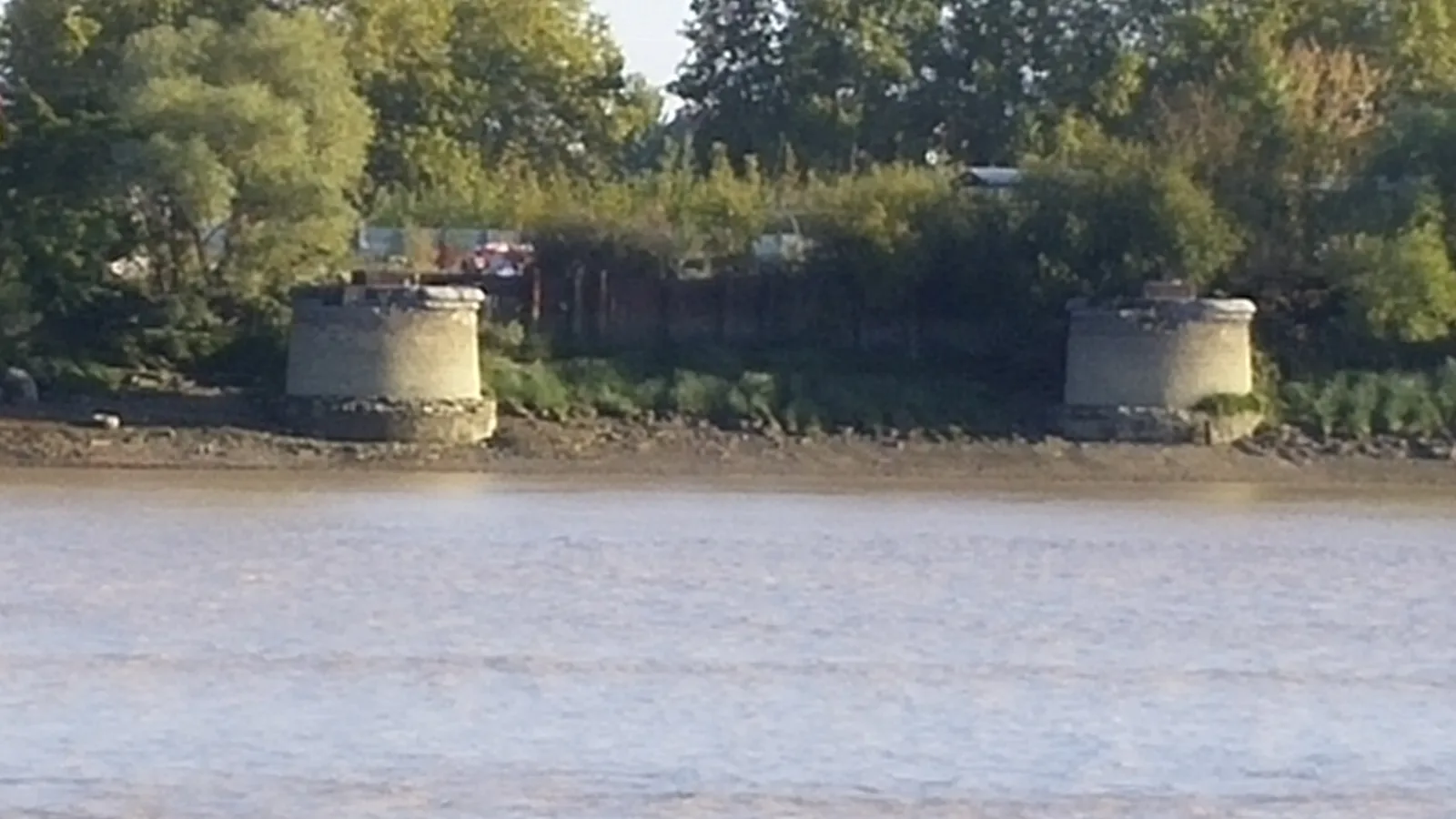
Urbex in Bordeaux has a quirk: the city itself, a UNESCO World Heritage site that is carefully maintained, offers very few genuine wastelands. Its abandoned places hide in the Gironde ring and along the Garonne: forgotten concrete blocks from a bridge that was never finished, wine chateaux left to the vegetation, bourgeois manors frozen for twenty years. Between the remains of the transporter bridge on the right bank and the ruined chateaux of the Entre-deux-Mers, Bordeaux urban exploration has to be earned. On our map, hundreds of geolocated spots cover the Gironde and the whole Nouvelle-Aquitaine region.
For this article we picked 4 places that are genuinely abandoned and still standing in 2026, each verified one by one: the anchoring blocks of a transporter bridge that was never completed, a fire-gutted chateau that became a local urbex legend, and two Gironde chateaux frozen by bankruptcy and exodus. No demolished spots, no renovated site passed off as a ruin, no half-active station dressed up as a wasteland. Under each entry, an "Add to my map" button saves the GPS coordinates to your personal account, for free and with no credit card.
The queries urbex Bordeaux, Bordeaux urbex map, abandoned places Bordeaux, urbex spot Bordeaux, urbex around Bordeaux and urban exploration Gironde all point to the same reality: an industrial, wine-growing and bourgeois heritage that history set aside through bankruptcies, wars and exodus, and that photographers, urbexers and historians are rediscovering today. This guide gives you each site's dated history, its legal status and its real dangers, before handing you its coordinates.
Free Bordeaux urbex: why Urbex Maps changes the game
Before the spots, a word on what makes this guide different. Most sites that talk about free urbex in Bordeaux put "free" in the title, then redirect you to a paid forum or a closed Telegram group. Here the promise is concrete: under each place, an "Add to my map" button sends the GPS coordinates to your personal account, with no subscription and no credit card.
Behind the map is a community of more than 40,000 explorers, active since 2021. Every coordinate is checked at least twice, by the contributor who submits it, then by a regional moderator who confirms the spot still exists and has not been walled up. The places offered in this article are part of that catalogue; the rest of the hundreds of Gironde spots are unlocked through packs that fund the moderation and field verification.
One reminder before you set off: urbex is not illegal in itself, but entering private property without permission is trespassing (article 226-4 of the French Penal Code, up to one year in prison and a 15,000 euro fine). We document these places for their history; we never encourage breaking in. Helmet, torch, ankle boots and caution on the floors: most of the spots below carry real collapse risks.
1. The transporter bridge piers - the ghost bridge of the Garonne (Bordeaux)

This is one of Bordeaux's quietest ghosts. Construction of the transporter bridge, designed by engineer Ferdinand Arnodin, began on 19 September 1910: a 400-metre structure was to cross the Garonne with a suspended gondola, without obstructing the ships sailing up to the stone bridge. The two 95-metre pylons were finished when the war halted the works in 1914. The bridge was never completed. The pylons were finally blown up by the Germans on 18 August 1942, to salvage the steel and deny Allied bombers a landmark towards the nearby submarine base.
What survives today are the stone anchoring blocks and foundations of the right-bank pylon, beside the Garonne, opposite the Cours du Medoc. They are massive blocks, silent witnesses to a Bordeaux that almost had its river cable car. It is a public vestige, visible from the outside: the draw is not infiltration but the industrial history and the raw photogenic quality of concrete and stone facing the river. A perfect entry point to understand Bordeaux urbex with zero legal risk.
The site is freely accessible from the right-bank quays: nothing to force, nothing to climb. Just take care near the water and on the slippery blocks. It is one of the few spots on this list you can visit with family, camera in hand, on foot or by bike from central Bordeaux. Best at the end of the day, when the low light strikes the blocks.
2. The Chateau du Grand Dragon - the fire-gutted ruin of Bouliac
About ten kilometres east of Bordeaux, on the hills of Bouliac, stands the best-known urbex spot in the metro area: a chateau nicknamed "the Grand Dragon". The first house at Le Dragon was built in 1862, then a grander chateau was completed around 1876 for major Bordeaux wine merchants. Occupied by the German army during the Second World War, turned into a retirement home in its last life, it was emptied and abandoned in the early 2000s. Theft, squatting and above all several fires reduced it to a ruin.
The estate is not just the main three-storey chateau: it also includes the caretaker's house at the park entrance, fine stables set around a courtyard, and above all a striking octagonal pigeon house at the centre. The roof has collapsed in places, the interiors are covered in graffiti and exposed to the weather, but the stone frame and the silhouette of the estate remain arresting. It is the archetypal abandoned Gironde chateau.
Private property: access is not authorised and all the original openings were walled up after years of damage. The risks are real: collapsed floors, a broken roof, falling stone and rubble. We document this place for its history, without encouraging intrusion. The exact coordinates of the estate are reserved for members: we name the nickname, we protect the owner.
3. The Chateau des Borges - the abandoned manor of Bruges
Immediately north of Bordeaux, in Bruges (Gironde), the Chateau des Borges is among the best-documented abandoned chateaux of the Gironde ring. Built around 1855-1860 and bought in 1870 by Pierre Bellemer, a merchant and mayor of Bruges, it passed to the town council in 1993 (used for a time as an archive store) before being left to decay; only its main body still stands today, at the heart of the Borges park. Like many of these large late-19th-century country estates, it was overtaken by land pressure and the expansion of the metro area. Cracked facades, sagging floors, empty rooms where vegetation creeps in: it offers the hushed atmosphere typical of the forgotten manors of the Bordeaux area.
It is a good example of our widening towards the outskirts: when the heart of Bordeaux has almost no real wastelands, we extend the radius towards Bruges, Blanquefort or Ambares, where chateau urbex is far richer. The place also shows how fragile these spots are: between property projects and demolitions, an abandoned Gironde chateau can vanish from one season to the next.
Private property: the interior is not accessible without permission. Standard risks of an old, unmaintained building: unstable floors, falling stone, a weakened roof structure, sometimes squatters. To be explored with the utmost caution and with strict respect for the place, without damaging or removing anything.
4. The Chateau Haut-Brignon - the ruined manor of Cenac
For anyone willing to drive about fifteen kilometres south-east of Bordeaux, in Cenac, the Chateau Haut-Brignon has become a Gironde urbex reference for its heavy atmosphere of a forgotten old manor. An eclectic residence from the second half of the 19th century, raised on the former noble house of Darmagnac, it was gradually abandoned in favour of the vineyard. Once a symbol of luxury and refinement, the manor is now in ruins: the dilapidated French architecture still keeps carved details that tell of past splendour. Nearby, the underground quarries of Cenac add a distinctive dimension to the area.
It is a private spot, abandoned but watched in places: we document it for its history and atmosphere, without encouraging intrusion, and we reserve the exact coordinates for members. As with the Grand Dragon, we keep the exact address reserved for members and protect the owner. Serious risks of a large ruined building: floors, staircases, roof structure, and unsecured galleries on the quarry side. Find every spot in the area on the Gironde map.
FAQ - Urbex Bordeaux
Is urbex legal in Bordeaux?
Urban exploration is not illegal in itself, but entering private property without permission is trespassing (article 226-4 of the French Penal Code). Most Bordeaux spots are private: we document them for their history, without ever encouraging break-ins. The transporter bridge piers, however, are freely accessible. For more, read our guide is urbex legal in France.
Where can I find other abandoned places around Bordeaux?
Our map lists hundreds of spots across the Gironde and the rest of Nouvelle-Aquitaine. You can add the four places in this article to your personal map for free via the button under each entry, then unlock the rest through our regional packs.
Why are there so few urbex spots in Bordeaux itself?
Because Bordeaux is a UNESCO World Heritage site under constant upkeep and rehabilitation: wastelands in the centre are quickly converted into housing, hotels or community venues. The genuine abandoned places are therefore mostly in the Gironde ring, which is why we chose to widen the radius to Bouliac, Bruges and Cenac rather than sell you renovated sites.
Do I need special gear to explore the abandoned chateaux?
For ruined chateaux like the Grand Dragon or Cenac, a head torch, a helmet and ankle boots are essential, because the floors and staircases are unstable. For the Cenac underground quarries, never venture in alone. Our urbex gear guide covers the essentials to start safely.
Conclusion: Bordeaux, a city that hides its ruins in the outskirts
From the transporter bridge piers to the hills of Bouliac, Bordeaux urbex tells a story of grand abandoned projects, wine-growing splendour and bourgeois manors overtaken by time. These places are not stage sets: they are open-air history books, fragile, to be explored with respect and without damage. Add them to your map, and carry on your exploration with our top 20 abandoned places in France, the urbex in Lyon guide or the free urbex map.