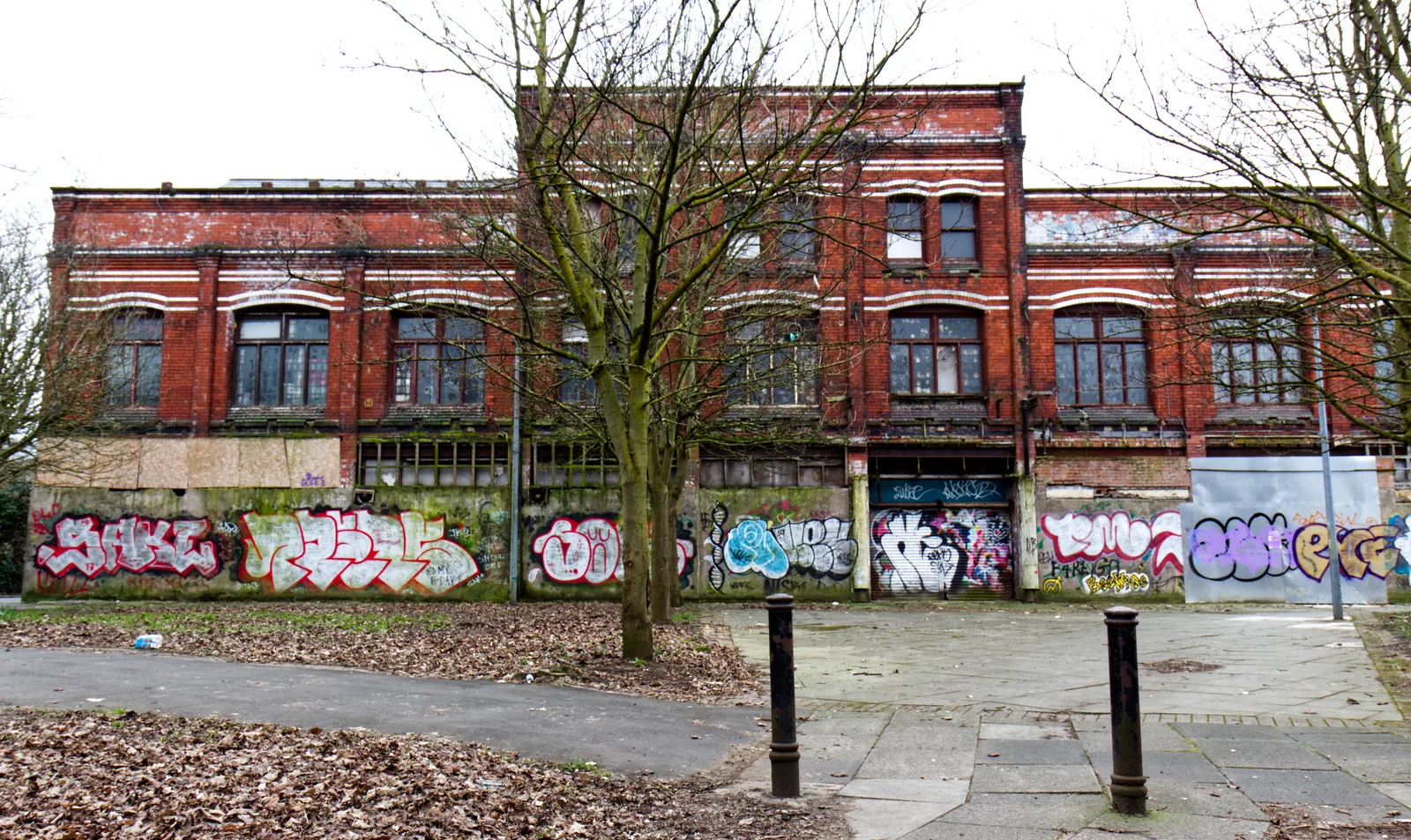
Abandoned places in Manchester tell the story of the world's first industrial city: cotton mills that fell silent, Edwardian theatres that went dark, and Victorian arches bricked up under the cathedral. The city that built the spinning machine has been tearing down and rebuilding itself ever since, which makes urban exploration here a race against the bulldozer. On our map, thousands of geolocated spots cover England and the whole of the United Kingdom.
For this guide we picked 5 places that are genuinely abandoned and still standing in 2026, each one checked against the latest news: a Grade II theatre rotting under a leaking roof, a listed 1960s college left empty since 2013, a 200-year-old cotton mill awaiting redevelopment, a dead shopping centre, and the sealed riverside arches that once sheltered Mancunians from the Blitz. We were strict on purpose: Manchester regenerates fast, so two of the city's most-photographed ruins (London Road Fire Station and the Ancoats Dispensary, now flats) have already left the urbex world. No demolished spots, no renovated site sold as a ruin.
The queries abandoned places Manchester, abandoned buildings Manchester, derelict Manchester and urbex Manchester all point to the same reality: a Victorian and industrial heritage that history set aside, and that photographers, urbexers and historians are rediscovering before the cranes arrive. Under each entry you get its dated history, its 2026 status, its legal situation and its real dangers - then an "Add to my map" button that saves the GPS coordinates to your personal account, for free and with no credit card.
Free Manchester urbex: why Urbex Maps changes the game
Before the spots, a word on what makes this guide different. Most sites that talk about free urbex in Manchester put "free" in the title, then push you toward a paid forum or a closed group chat. Here the promise is concrete: under each place, an "Add to my map" button sends the GPS coordinates to your personal account, with no subscription and no credit card.
Behind the map is a community of more than 40,000 explorers, active since 2021. Every coordinate is checked at least twice - by the contributor who submits it, then by a regional moderator who confirms the spot still exists and has not been demolished or walled up. That double-check matters more in Manchester than almost anywhere: mills here burn or fall every year. The places offered in this article are part of that catalogue; the rest of the UK spots are unlocked through packs that fund the moderation and field verification.
One reminder before you set off: urbex is not illegal in itself, but entering a building or land without the owner's permission is trespassing, and forcing an entry or causing damage can become a criminal offence under the Criminal Damage Act 1971. We document these places for their history; we never encourage breaking in. Helmet, torch, sturdy boots and a dust mask: several of the spots below carry real risks of collapse, asbestos and deep falls.
1. Hulme Hippodrome - the rotting Edwardian theatre (Hulme)

Opened on 7 October 1901 as the Grand Junction Theatre and Floral Hall, designed by architect Joseph John Alley on Warwick Street, the Hulme Hippodrome is the surviving half of a twin variety palace built for the Broadhead theatre circuit. Laurel and Hardy and Nina Simone played its stage; the BBC recorded the first three series of the Morecambe and Wise radio show here in the 1950s. It became a bingo hall, then a church, and has stood empty since 2018. This Grade II listed music hall is now on Manchester's Buildings at Risk register.
Inside, the ornate plasterwork, the two galleries and the proscenium arch are still astonishing - and increasingly fragile. A 2024 survey by the Save Hulme Hippodrome campaign found growing holes in the roof letting water destroy the historic fibrous plaster; the building has no electricity or running water. The council served the owner a Section 215 repairs notice, and the community group has raised tens of thousands of pounds, but no full restoration has started in 2026, so for now it remains a genuine ruin.
The site is private, boarded up and not authorised for access. Risks are real: rotten floors and balconies, falling plaster, total darkness, no services. A helmet and a strong torch are essential, and the upper galleries should be treated as unsafe. Hulme is a ten-minute ride from the city centre, off Princess Road. Hulme Hippodrome is the single most important abandoned building in central Manchester: see it documented, and support the campaign to save it.
2. The Toast Rack - the empty pop-architecture college (Fallowfield)

In Fallowfield, south Manchester, the Toast Rack is one of Britain's most loved pieces of pop architecture: a concrete frame of fourteen curved ribs resembling a toast rack, with a circular restaurant block nicknamed the "Fried Egg". It was built between 1957 and 1960 by Manchester city architect Leonard Cecil Howitt as the Municipal Domestic and Trades College, later the Hollings campus of Manchester Metropolitan University. Teaching ended in 2013, and the building, Grade II listed in 1998, has stood empty ever since.
Bought by developers in 2014 and marketed again in 2023 with consent for around 200 homes, the Toast Rack is the textbook "window closing" spot: the listed shell will be kept, but conversion into flats has been planned for years and could begin at any time. As of 2026 it remains fenced, vacant and unconverted. It is private property and access is not authorised; like many empty 1960s buildings it carries asbestos risks, plus the usual hazards of an unmaintained structure. The Toast Rack is best appreciated as a photographer's icon from the perimeter - and a reminder of how fast Manchester reuses its landmarks.
3. Compstall Mills - the 1820 cotton mill by the Etherow (Stockport)

On the eastern edge of Greater Manchester, beside the river Etherow and the Etherow Country Park, Compstall Mills is a vast former cotton complex built from 1820 by the industrialist George Andrew. The mill ran alongside a purpose-built village for some 800 workers - one of the region's classic mill communities. It is the kind of raw industrial ruin that the Manchester city centre has mostly lost: crumbling weaving sheds, a chimney, broken machinery and the slow return of nature.
The site is derelict but watched, and slated for redevelopment: a company named Compstall Mill 2025 Ltd bought the four-acre estate at auction and is drawing up plans for up to 135 homes, so this window is closing too. As of 2026 the historic buildings are still standing. This is private land within a conservation area; access is not authorised, and the dangers are those of any old mill - unstable floors, falling masonry and a serious fire history across the region's empty mills. Compstall is the spot to understand why widening the radius beyond the city centre is often the only honest way to find raw industrial urbex around Manchester. Explore the wider area on the Stockport map.
4. Wheatsheaf Shopping Centre - the dead mall (Rochdale)

North of Manchester, in the town centre of Rochdale, the Wheatsheaf Shopping Centre is a "dead mall": a complete 1990 shopping precinct of some 15,000 square metres, with retail units, offices and a two-storey library, frozen in time. It lost its anchor tenants from 2017 - Rymans, Wilko, Argos, BrightHouse - then closed for the Covid lockdowns in 2020 and never reopened. The result is an eerie indoor street of empty shopfronts, dead escalators and faded signage that has drawn urban explorers from across the UK.
The centre is still standing in 2026, but change is coming: plans approved by Rochdale Council will turn the upper floors, where the library once sat, into banqueting and events halls, so the dead-mall atmosphere has a shelf life. It is private property and not open to the public; access is not authorised. Risks are those of a large empty building - poor light, debris, possible loose fixtures. The Wheatsheaf is one of the most atmospheric "abandoned buildings Manchester" explorers reference, and a textbook example of the post-retail ruin. More spots in the area on the Rochdale map.
5. Victoria Arches - the sealed Blitz shelters under the cathedral

Right in the heart of the city, set into the embankment of the River Irwell in front of Manchester Cathedral, the Victoria Arches are a row of brick arches built in the 1830s when Hunt's Bank was widened into what is now Victoria Street. Their seventeen arches served as business premises, as landing stages for steam-packet riverboats, and - most memorably - as Second World War air-raid shelters, fitted with blast walls to protect 1,619 people at a cost of just over 10,000 pounds.
This is a spot for the imagination rather than the boots. The underground toilets closed in 1967, the staircases were removed, and the entrances were securely bricked up: in 2026 the arches are sealed and genuinely inaccessible. We include them because they are one of Manchester's great hidden ruins, visible from across the Irwell and from Cathedral Approach, and a vivid reminder of the city's wartime underground. There is no legal way in and we do not encourage attempts; treat this as a place to read, photograph from the riverside, and remember. For the abandoned places you can actually add to your map, see the four spots above and the wider Manchester map.
FAQ - Abandoned places in Manchester
Is urbex legal in Manchester?
Urban exploration is not illegal in itself, but entering a building or land without the owner's permission is trespassing, and forcing entry or causing damage can be a criminal offence under the Criminal Damage Act 1971. Almost every spot in this guide is private or council-owned. We document these places for their history and never encourage breaking in.
Where can I find more abandoned buildings around Manchester?
Our map lists spots across England and Greater Manchester, including Stockport and Rochdale. You can add the spots in this article to your personal map for free via the button under each entry, then unlock the rest through our packs. For the bigger picture, read our pillar guide to the most iconic abandoned places in the UK.
Why are so many Manchester spots demolished or converted?
Manchester is one of the fastest-regenerating cities in Europe. Famous ruins like London Road Fire Station (now a hotel scheme) and the Ancoats Dispensary (now apartments, reopened 2025) have already left the urbex world, and mills are lost to fire or the bulldozer every year. That is exactly why our community re-checks each coordinate, and why this guide is dated 2026 and honest about every status.
What gear do I need to explore safely?
A helmet, a powerful torch and sturdy boots are the minimum; a dust mask is wise in old mills and the Toast Rack because of asbestos. Never explore derelict buildings alone, and avoid upper floors and galleries where collapse is a real risk - particularly at Hulme Hippodrome. Tell someone where you are going.
Can I visit Victoria Arches?
No. The Victoria Arches were securely bricked up after 1967 and remain sealed in 2026, with the staircases removed. There is no legal access. They are best appreciated from across the River Irwell or from Cathedral Approach, as a piece of Manchester's hidden wartime history.
Conclusion: Manchester, a city that keeps rebuilding over its ruins
From a leaking Edwardian theatre in Hulme to the sealed Blitz shelters under the cathedral, the abandoned places of Manchester are not stage sets - they are the fabric of the first industrial city, fragile and disappearing fast. The cotton mill, the variety palace, the pop-architecture college and the dead mall each mark a chapter the city has moved past. Explore them with respect and without damage, add the four accessible spots to your map, and carry on with our guide to the most iconic abandoned places in the UK or the free urbex map.