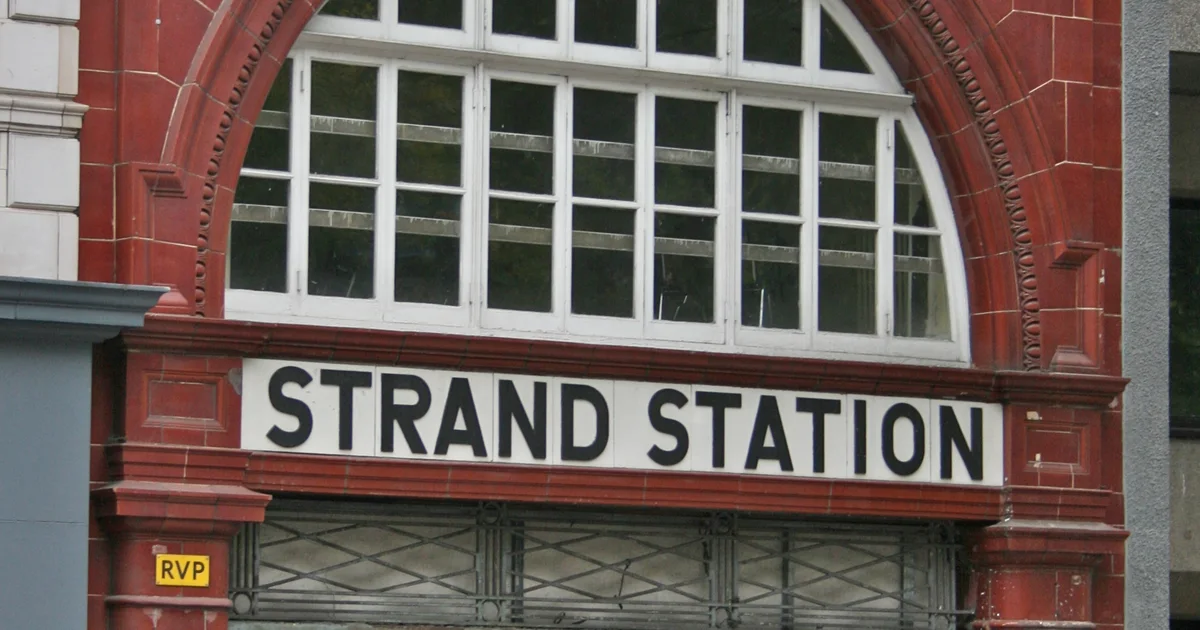
Abandoned places in London hide in plain sight: behind an oxblood-red faience facade on the Strand, under the parade where the Crystal Palace once stood, along a railway swallowed by trees, and beneath the cobbles of Camden. A city this dense leaves few empty buildings standing for long, yet its layers of disused railways, Victorian infrastructure and dockland ruins make it one of the richest urban exploration playgrounds in Britain. On our map, thousands of geolocated spots cover the United Kingdom.
For this guide we picked 5 places that are genuinely disused and still standing in 2026, each checked one by one: the most famous of London's disused Underground stations, an ornate Victorian subway, a derelict dockland flour mill with a closing window, an abandoned railway turned nature reserve, and a sealed network of horse tunnels. No demolished landmarks dressed up as ruins. Under each entry, an "Add to my map" button saves the GPS coordinates to your personal account, for free and with no credit card.
The queries abandoned places London, abandoned buildings in London, disused London Underground stations, derelict London and urbex London all point to the same reality: a layered industrial, transport and imperial heritage that history set aside, through Blitz damage, dock closures, railway cuts and changing fashions, and that explorers, photographers and historians are rediscovering today. This guide gives you each site's dated history, its legal status and its real dangers, before handing you its coordinates.
Free London urbex: why Urbex Maps changes the game
Before the spots, a word on what makes this guide different. Most sites that talk about free urbex in London put "free" in the title, then redirect you to a paid forum or a closed group. Here the promise is concrete: under each place, an "Add to my map" button sends the GPS coordinates to your personal account, with no subscription and no credit card.
Behind the map is a community of more than 40,000 explorers, active since 2021. Every coordinate is checked at least twice, by the contributor who submits it, then by a regional moderator who confirms the spot still exists and has not been walled up or demolished. The places offered in this article are part of that catalogue; the rest of the thousands of spots across the UK are unlocked through packs that fund the moderation and field verification.
One reminder before you set off. In England and Wales, simple trespass on private land is usually a civil matter, but entering a building or railway property without permission can be a criminal offence, and going onto the railway is prosecuted under the British Transport Police and the Railways Act. We document these places for their history; we never encourage breaking in. Two of the five sites below are best seen on an official, ticketed visit, which we always recommend over sneaking in.
1. Aldwych disused Underground station - the most famous ghost station (Strand, WC2)

Aldwych is the most famous of London's disused Underground stations. Opened on 30 November 1907 as "Strand", on a short single-stop branch of the Piccadilly line from Holborn, it was renamed Aldwych in 1915. The station building, with its signature oxblood-red faience, was designed by Leslie Green. Lightly used from the start, it sheltered Londoners during both World Wars and stored treasures from the British Museum and the National Gallery, reportedly including the Elgin Marbles. It finally closed on 30 September 1994, when replacing its ageing lifts could not be justified for so few passengers.
The station survives almost intact and is Grade II listed, which is why film crews use it constantly, from Atonement to Sherlock. Inside you will find a period ticket hall, a lift, original Leslie Green tiling and a platform left frozen in time, complete with vintage Underground roundels and advertising. The disused running tunnels have even been used in connection with engineering works at Bank station.
This is a spot you visit the right way. The station is sealed and owned by Transport for London, so there is no informal access, but the London Transport Museum runs official "Hidden London" tours of Aldwych through the year. Booked tours sell out fast and are by far the safest, and only legal, way inside. The meeting point is on Surrey Street, just off the Strand, a short walk from Temple and Holborn stations.
Aldwych is the obvious starting point for anyone fascinated by abandoned London: a complete Edwardian station you can actually walk through.
2. Crystal Palace Subway - the hidden Byzantine cathedral (SE19)

Beneath Crystal Palace Parade lies one of the most beautiful pieces of forgotten London: the Crystal Palace Subway. Built in 1865 to a design by Charles Barry Junior and laid by Italian cathedral craftsmen, this fan-vaulted, polychrome-brick passage carried first-class rail passengers from the Crystal Palace High Level station to the great glass Palace above. The Palace burned down in 1936, the High Level station closed in 1954 and was demolished, and the subway became a hidden survivor, its Byzantine arches earning it the nickname of an underground cathedral.
The subway is Grade II* listed and, unlike most abandoned places, it has been saved: a major restoration was completed in 2024, ahead of its 160th anniversary, by the Crystal Palace Park Trust and the Friends of Crystal Palace Subway. Sealed for decades, it is no longer derelict but conserved, and that changes how you see it.
Access is on scheduled open days run by the Trust and the Friends group, usually a few times a year and free or low-cost. There is no informal entry, the gates are locked between events. Check the Crystal Palace Park Trust calendar before you travel; the entrance is on Crystal Palace Parade, near the bus station, a short walk from Crystal Palace railway station. It is the most photogenic abandoned interior in south London, and you can see it legally.
3. Millennium Mills - the dockland giant on borrowed time (Silvertown, E16)

On the south side of the Royal Victoria Dock stands the most cinematic ruin in London: Millennium Mills. Built in 1905 for the millers William Vernon and Sons, damaged in the 1917 Silvertown explosion and rebuilt as a ten-storey Art Deco flour mill in 1933, it has stood derelict since the Royal Docks closed in 1981. Its hollow concrete halls and the "Spillers" lettering have appeared in 28 Weeks Later, Ashes to Ashes and countless music videos, making it the spiritual home of London urbex.
This is the spot with a closing window. On 13 December 2025, Newham Council approved an updated Silvertown Quays masterplan for thousands of new homes, schools and shops. Crucially, the Mills and the neighbouring listed Silo D are to be retained and restored rather than demolished, but the building will eventually be reborn as offices, restaurants and cultural space. In other words, the derelict Millennium Mills you read about will not exist for much longer.
For now it remains a fenced-off, derelict construction and regeneration site, with no public access and no tours. The hazards are serious: unstable floors, deep dock water, contamination and active site security. We document it because it is one of the defining abandoned buildings in London, and a textbook case of a ruin being reclaimed by the city. You can still photograph its hulk from across the dock or from the Emirates Air Line cable car. Find every spot in the area on the United Kingdom map.
4. Parkland Walk - the railway swallowed by the forest (N4 to N6)

The Parkland Walk is the closest thing London has to an abandoned railway you can walk for free. The line opened on 22 August 1867, built by the Edgware, Highgate and London Railway and soon absorbed by the Great Northern; passenger services ended in 1954, freight by the 1960s, and empty tube stock rattled through until 1970. Reborn as a footpath in 1984 and declared a Local Nature Reserve in 1990, it now runs from Finsbury Park towards Highgate through a green corridor of cuttings, bridges and the ruined platforms of the old Crouch End station.
The walk's eeriest feature is the Spriggan, a goblin-like figure by sculptor Marilyn Collins (1993) that appears to climb out of a brick arch near Crouch End. Despite a popular legend, it post-dates Stephen King's short story "Crouch End", so it cannot have inspired it, but it gives the abandoned platforms a genuinely uncanny atmosphere. The disused tunnels near Highgate are sealed and home to bats; do not try to enter them.
This is the easiest spot here: open access, free and legal, daily during daylight hours, managed by the boroughs of Haringey and Islington. Take care on uneven ground and overgrown sections, and respect the wildlife. Nearest stations are Finsbury Park at one end and Highgate at the other. Parkland Walk is the gentle introduction to abandoned London, no permission and no risk-taking required.
5. Camden Catacombs - the horse tunnels under the market (NW1)

Beneath the crowds of Camden Market lies a labyrinth almost no one is allowed to see: the Camden Catacombs. These are not burial vaults but 19th-century horse tunnels: two main bores were built in 1856 and a wider network from 1865, so that the hundreds of railway horses and pit ponies stabled along Chalk Farm Road could reach the Camden Goods Yard without crossing the tracks. The cast-iron grilles still set into the pavement were once the animals' only daylight.
Today the tunnels are owned by Network Rail and are largely sealed, with no public access, closed off because of flooding and safety risks, and partly lost to redevelopment. We are deliberately not treating this as a spot to enter: trespassing on railway infrastructure is a criminal matter and the flooded tunnels are genuinely dangerous. It is here as a piece of hidden history rather than an invitation.
The good news is that you can legally taste the atmosphere. The northern end of the network has been converted into the Horse Tunnel Market, part of Stables Market, where you can walk through original brick arches once used by the horses. It is the only walkable remnant of the catacombs, and a fitting way to end a tour of abandoned London: a Victorian tunnel given a second life rather than left to rot.
FAQ - Abandoned places in London
Is urbex legal in London?
Urban exploration is not illegal in itself, but in England and Wales entering a building without permission can be a criminal offence, and going onto railway property is prosecuted by the British Transport Police. We document these places for their history and never encourage break-ins. For the two finest interiors, Aldwych and the Crystal Palace Subway, official ticketed visits exist, which is always the route we recommend.
Can I visit a disused London Underground station?
Yes, legally and safely. The London Transport Museum runs "Hidden London" tours of disused stations including Aldwych and Down Street, the secret wartime bunker used by Churchill. Other ghost stations such as Brompton Road and the demolished British Museum station are not open, but Aldwych is the one to book first.
Which abandoned places in London can I see for free?
The Parkland Walk is open to all, free and legal, every day during daylight, with ruined platforms and the Spriggan sculpture. The Crystal Palace Subway opens free or cheaply on scheduled days. You can also add the five places in this article to your personal map for free via the button under each entry, then unlock more across the country through our UK packs.
Do I need special gear to explore abandoned places in London?
For the official tours and the Parkland Walk, sturdy footwear is enough. For any derelict building, a head torch, gloves and ankle boots are sensible, and you should never enter flooded tunnels or unstable structures like Millennium Mills. Our urbex gear guide covers the essentials to start safely.
Where can I find other abandoned places near London?
Our map lists spots across Greater London and the home counties, from derelict hospitals to disused military sites. You can explore the wider catalogue on the United Kingdom map and unlock regional packs that fund the field verification keeping each coordinate accurate.
Conclusion: London, a city of hidden layers
From a frozen Edwardian platform under the Strand to a Byzantine subway, a dockland giant on borrowed time, a railway turned forest and tunnels built for horses, abandoned London tells the story of a city forever rebuilding over its own past. These places are not stage sets: they are open-air history books, fragile, to be explored with respect and, where official visits exist, the legal way. Add them to your map, and carry on your exploration on the United Kingdom map or the free urbex map.