Urbex in Rouen has a flavour all its own: that of a great Seine port where industry rose and then ebbed, and of a Normandy bristling with medieval chateaux left in ruins above the river. Between the monumental port wine warehouse sealed up on the Waddington peninsula, the forgotten fortresses overlooking the lower Seine and the valleys of the Pays de Caux, Rouen's urban exploration scene asks you to widen the radius a little - but it rewards you. On our map, thousands of geolocated spots cover Seine-Maritime and the whole Normandy region.
For this article we picked 3 places that are genuinely abandoned and still standing in 2026, each verified one by one: a monumental port wasteland in the heart of Rouen, and two chateaux listed as Historic Monuments, to be viewed from the outside, along the Seine and near Dieppe. No demolished spots, no renovated site passed off as a ruin. Under each entry, an "Add to my map" button saves the GPS coordinates to your personal account, for free and with no credit card.
The queries urbex Rouen, Rouen urbex map, abandoned places Rouen, urbex spot Rouen, urbex around Rouen and urban exploration Seine-Maritime all point to the same reality: a port, industrial and aristocratic heritage that history set aside - economic decline, wars, aborted property schemes - and that photographers, urbexers and historians are rediscovering today. This guide gives you each site's dated history, its legal status and its real dangers, before handing you its coordinates.
Free Rouen urbex: why Urbex Maps changes the game
Before the spots, a word on what makes this guide different. Most sites that talk about free urbex in Rouen put "free" in the title, then redirect you to a paid forum or a closed Telegram group. Worse, many commercial maps hide the places under unverifiable fictional names. Here the promise is concrete: under each place, an "Add to my map" button sends the GPS coordinates to your personal account, with no subscription and no credit card.
Behind the map is a community of more than 40,000 explorers, active since 2021. Every coordinate is checked at least twice - by the contributor who submits it, then by a regional moderator who confirms the spot still exists and has not been walled up. The places offered in this article are part of that catalogue; the rest of the thousands of French spots are unlocked through packs that fund the moderation and field verification.
One reminder before you set off: urbex is not illegal in itself, but entering private property without permission is trespassing (article 226-4 of the French Penal Code, up to one year in prison and a 15,000 euro fine). We document these places for their history; we never encourage breaking in. Helmet, torch, ankle boots and caution: two of the three spots below are ruins closed to the public, to be observed from the outside.
1. The port wine warehouse - the walled-up giant of the peninsula (Rouen)

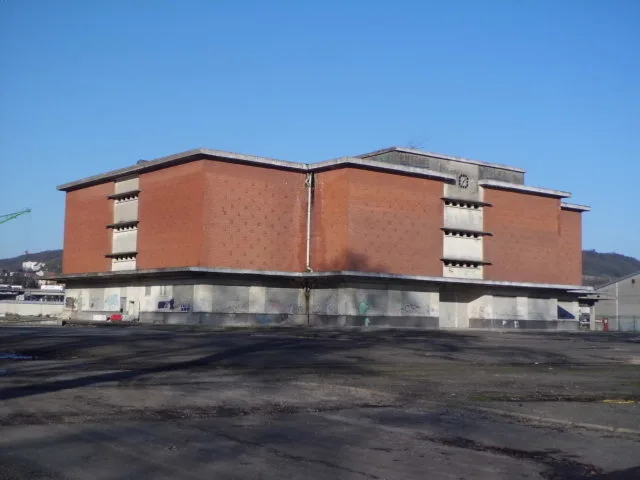
By the Saint-Gervais dock, on the Waddington peninsula, stands a mass of brick and concrete that was once the largest wine warehouse in Europe. Inaugurated on 15 December 1950 (architect Pierre-Maurice Lefebvre), it was designed to receive, store and redistribute to Paris the wine imported from North Africa - up to 100,000 hectolitres in vats arranged in a cross over three floors. Activity ceased around 1968; the building then served as the port's customs office until 1993, after which it was closed. Source: Wikipedia.
Now walled up after being looted (all the copper piping is gone) and vandalised, the wine warehouse has become a legendary spot of Norman urbex, heavily photographed - notably by Florent Devauchel. A casino project, selected under the "Reinventing the Seine" scheme in 2017, was abandoned in January 2021; since then no demolition or conversion has been undertaken and the giant still awaits a project.
The building is walled up and access is officially sealed: it is above all a spot to observe and photograph from the quay and the Boulevard Richard-Waddington. Its massive port architecture makes it one of the most impressive abandoned backdrops in central Rouen, just minutes from the centre. Standard risks of a sealed industrial wasteland: degraded structure, chutes and hoppers, unstable floors.
The wine warehouse remains the most iconic urbex spot in Rouen: the best entry point to understand the city's port past.
2. Chateau de Tancarville - the imperilled fortress over the Seine (Tancarville)

About forty kilometres west of Rouen, the Chateau de Tancarville overlooks the Seine from a chalk-cliff spur. Founded in the 11th century by Raoul de Tancarville and extended through to the 18th century, it has been listed as a Historic Monument since 1862. But the fortress is now abandoned and in peril: owned by a real-estate company (S.C.I. Saqqara) since the early 2000s, it was meant to be turned into luxury apartments via heritage tax breaks - a project never completed, in which only a section of roof was apparently repaired.
The chateau is closed to the public and the access road has been sealed off by the local authorities for fear the walls might collapse: it is a spot to observe from the Seine footpaths, not a place to enter. It embodies "forgotten" heritage in danger - keep, towers and main building frozen above the river, slowly reclaimed by vegetation. Treat it as a watched monument-ruin to be seen from the outside, not as an accessible playground.
Tancarville is probably the most spectacular ruin of the lower Seine: one to photograph before a restoration - or a collapse - changes its face.
3. Chateau d'Arques-la-Bataille - the mighty ruins near Dieppe (Arques-la-Bataille)

About fifty kilometres north of Rouen, just south-east of Dieppe, the Chateau d'Arques-la-Bataille raises imposing ruins on a spur between two valleys. The first wooden fortress was built around 1040-1045 by William of Arques and rebuilt in stone from the 12th century; the site has been listed as a Historic Monument since 1875. It was here in 1589 that Henri IV pushed back the troops of the Catholic League. The southern gate-tower was destroyed by the explosion of German ammunition stores in 1944.
Important: the interior of the chateau has been closed to the public for safety reasons (falling stones) and the entrances have been locked ever since. So it is not a "penetrable" urbex spot but a powerful ruin to walk around from the outside, along the moat - long curtain walls flanked by about a dozen towers around a Romanesque keep. The "Sauvegardons le chateau d'Arques" association occasionally runs guided tours of the ruins; the State carries out consolidation works there.
Arques perfectly illustrates our approach: when a city does not have five genuine spots at its core, we widen the radius towards real ruins rather than sell you renovated sites. Find every spot in the area on the Seine-Maritime map.
FAQ - Urbex Rouen
Is urbex legal in Rouen?
Urban exploration is not illegal in itself, but entering private property without permission is trespassing (article 226-4 of the French Penal Code). Most Rouen spots are private, closed or walled up: we document them for their history, without ever encouraging break-ins. For more, read our guide is urbex legal in France.
Where can I find other abandoned places around Rouen?
Our map lists thousands of spots across Seine-Maritime and the rest of Normandy. You can add the three places in this article to your personal map for free via the button under each entry, then unlock the rest through our regional packs.
Can I visit the Chateau de Tancarville?
No: the Chateau de Tancarville is closed to the public and the access road has been sealed off for fear the walls might collapse. It is an imperilled ruin to be observed from the outside, along the Seine footpaths. The Chateau d'Arques-la-Bataille, also closed for safety reasons, can be seen from the outside around the moat, and its ruins are sometimes the subject of guided tours run by a local association.
Do I need special gear to explore around Rouen?
Since the three places in this guide are closed and meant to be seen from the outside, the essentials are good shoes and caution nearby (falling stones at Arques and Tancarville, unstable floors at the wine warehouse). If you explore other wastelands in the region, a powerful head torch, a helmet and ankle boots remain essential. Our urbex gear guide covers the essentials to start safely.
Conclusion: Rouen, between port wastelands and Norman ruins
From the walled-up wine warehouse of the port to the forgotten fortresses of the lower Seine and the Dieppe country, Rouen urbex tells a century and a half of history: the grandeur of a merchant port, aborted property schemes and the slow agony of Normandy's medieval chateaux. These places are not stage sets: they are open-air history books, fragile, to be explored with respect and without damage. Add them to your map, and carry on your exploration with the free urbex map or our Normandy spots.