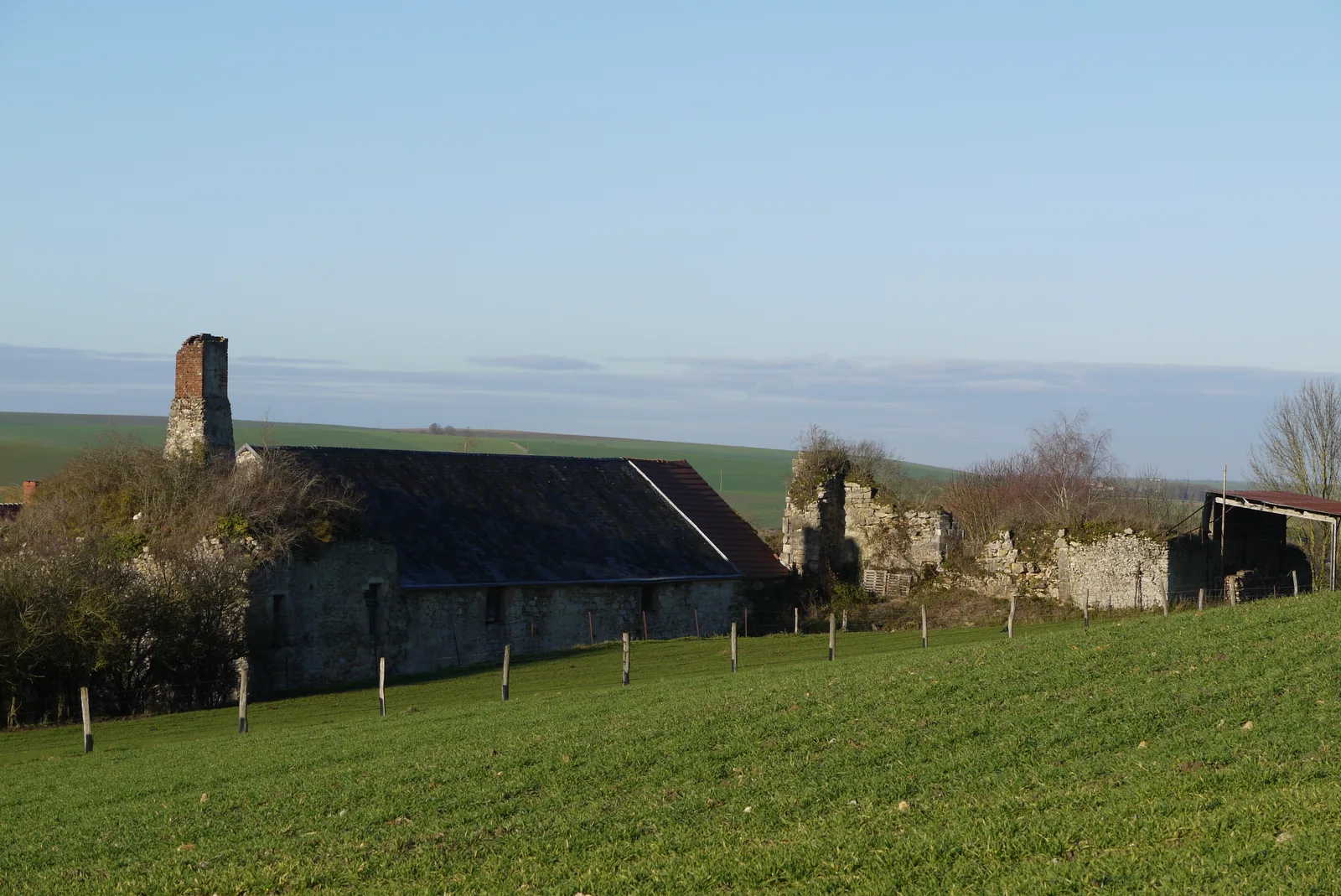
Urbex in Reims deserves an honest opening: the coronation city is rich in cathedral, champagne cellars and history, but poor in verifiable abandoned places within the city itself. The ring of forts around it - Pompelle, Brimont, Nogent-l'Abbesse, Saint-Thierry - is either turned into a museum, run by associations, or demolished for its stone. The real spots, the ones still standing, abandoned and free, are less than 40 km away, in the south of the Aisne: so we widen the radius rather than sell you renovated sites. On our map, thousands of geolocated spots cover the Aisne and the whole Hauts-de-France region.
For this article we picked 3 places that are genuinely abandoned and still standing in 2026, each verified one by one: two ruined medieval chateaux of the Tardenois and a third, more fragmentary ruin in the forest for those who want to push further. No fort turned into a museum, no inhabited chateau passed off as a ruin. Under each entry, an "Add to my map" button saves the GPS coordinates to your personal account, for free and with no credit card.
The queries urbex Reims, Reims urbex map, abandoned places Reims, urbex spot Reims, urbex around Reims and urban exploration Aisne all point to the same reality: an aristocratic and medieval heritage that history set aside - wars, fires, royal dismantlements, the battles of 1914-1918 - and that photographers, urbexers and historians are rediscovering today. This guide gives you each site's dated history, its legal status and its real dangers, before handing you its coordinates.
Free Reims urbex: why Urbex Maps changes the game
Before the spots, a word on what makes this guide different. Most sites that talk about free urbex in Reims put "free" in the title, then redirect you to a paid forum or a closed Telegram group - and often list spots under fictional names ("disused Reims hospital", "Dormans manor") that are impossible to verify. Here the promise is concrete: under each place, an "Add to my map" button sends the GPS coordinates to your personal account, with no subscription and no credit card.
Behind the map is a community of more than 40,000 explorers, active since 2021. Every coordinate is checked at least twice - by the contributor who submits it, then by a regional moderator who confirms the spot still exists and has not been walled up. The places offered in this article are part of that catalogue; the rest of the thousands of French spots are unlocked through packs that fund the moderation and field verification.
One reminder before you set off: urbex is not illegal in itself, but entering private property without permission is trespassing (article 226-4 of the French Penal Code, up to one year in prison and a 15,000 euro fine). We document these places for their history; we never encourage breaking in. Helmet, torch, ankle boots and caution: these medieval ruins carry very real falling-stone risks.
1. Chateau de Rognac - the keep split in two (Coulonges-Cohan, Aisne)

About thirty kilometres south-west of Reims, deep in the Tardenois, the Chateau de Rognac is the ruin of a 13th-century fortified manor. Captured and burned in the mid-14th century, it was never rebuilt: it has stood as ruins for nearly seven centuries. You can still see a literally cracked square keep, a fortified gate and an old communal oven. Only that oven is listed as a Historic Monument (1928) - the manor itself is neither a museum, nor laid out for visitors, nor managed: it is a genuinely forgotten ruin.
The site is private property: access is not laid out and not authorised. The "Les Jacques de Rognac" association occasionally fires the communal oven, but that does not make the manor an open site. Watch out for hunting seasons in the surrounding woods, and for falling stone from medieval masonry weakened by the centuries. It is the archetypal forgotten chateau of north-eastern France: to be observed with respect, without damaging anything.
Rognac is the most solid spot in the Reims ring: an authentic medieval ruin, still standing, and the best entry point into the chateau urbex of the southern Aisne.
2. Chateau de Fere-en-Tardenois - the ruin with a Renaissance bridge (Aisne)

About 38 km south-west of Reims, the Chateau de Fere-en-Tardenois is one of the most spectacular medieval ruins in the Aisne. The castle was raised in the early 13th century by Robert de Dreux, around a heptagonal courtyard flanked by towers. Its jewel is from the Renaissance: around 1560, architect Jean Bullant built a monumental gallery-bridge of five arches, 60 metres long, spanning the moat - and still standing today. The castle has been a listed Historic Monument since 1862.
The decline began in 1779, when Philippe d'Orleans (Philippe-Egalite) had the roofs and materials sold off; the fighting of the First World War, with German explosives tests, finished reducing the whole site to ruins. The status to know honestly: the ruins are owned by the department and access to the site is free and open all year (free parking), with optional paid guided tours via the tourist office. So it is a "technically managed" site, but one that remains an unwalled, unmuseumified ruin - nothing like a closed museum such as the Pompelle.
Don't confuse them: the adjacent "Chateau de Fere" hotel is a separate private property, not the ruins. On site, take care under the gallery-bridge and along the high masonry. Fere-en-Tardenois is the most photogenic spot in the Reims radius: a free-access abandoned castle, which is rare enough to be worth stressing.
3. Chateau de la Folie d'Aigremont - the ruins in the forest (Cerseuil, Aisne)

For those who want to push the exploration further, about 37 km west of Reims, the Chateau de la Folie d'Aigremont is a ruined castle lost in the woods overlooking the Vesle valley, one kilometre south-west of Braine. Built in the early 13th century by Robert II de Dreux, it was dismantled in 1427 on the orders of Charles VII, then long left in ruins and further damaged by the First World War. Today only thin remains survive - moats cut into the limestone, fragments of towers and curtain walls - heavily overgrown.
Be clear-eyed about this spot: it is a genuine abandoned, unmanaged ruin, but it is fragmentary and not very spectacular, and the site is fenced off because of falling-stone danger - so access is restricted in practice. We mention it for honesty, as a "bonus" for anyone who has already done Rognac and Fere and wants to round out a day in the Soissonnais. As no free-licensed photo of the site exists, we illustrate it here with a real photo of the ruins credited to its author. Aigremont perfectly illustrates our approach: when a city does not have five genuine spots at its core, we widen the radius rather than sell you renovated sites. Find every spot in the area on the Aisne map.

FAQ - Urbex Reims
Is urbex legal in Reims?
Urban exploration is not illegal in itself, but entering private property without permission is trespassing (article 226-4 of the French Penal Code). The southern-Aisne chateaux featured here are private or departmental property: we document them for their history, without ever encouraging break-ins. For more, read our guide is urbex legal in France.
Why aren't the spots inside Reims itself?
Because we have to be honest: central Reims is poor in verifiable abandoned places. The belt forts (Pompelle, Brimont, Nogent-l'Abbesse, Saint-Thierry) are museumified, run by associations or demolished for their stone, and the nearby Mourmelon camp is an active military base. The real spots, standing and free, are ruined medieval chateaux in the southern Aisne, less than 40 km away: so we widen the radius rather than inventing fictional spots.
Do I need special gear for these chateau ruins?
For medieval ruins like Rognac, Fere-en-Tardenois or Aigremont, the essentials are good ankle boots, caution against falling stone and unstable ground, and vigilance during hunting season in the woods. A torch is useful for the low, vaulted parts. Our urbex gear guide covers the essentials to start safely.
Can I visit Chateau de Fere-en-Tardenois legally?
Yes: it is the special case in this selection. The ruins are owned by the department and access to the site is free and open all year, with free parking; optional paid guided tours are offered by the tourist office. Rognac and Aigremont, on the other hand, are private properties where access is not authorised - to be observed with caution and full awareness of the legal risks.
Conclusion: Reims, an exploration that plays out in the Tardenois
Reims is not an urbex city in the classic sense: its military heritage is locked down, managed or demolished, and the commercial maps invent spots that do not exist. But less than 40 km away, in the southern Aisne, three ruined medieval chateaux tell eight centuries of history - sieges, fires, royal dismantlements, the battles of 1914-1918. These places are not stage sets: they are open-air history books, fragile, to be explored with respect and without damage. Add them to your map, and carry on your exploration with our guide on the legality of urbex or the free urbex map.