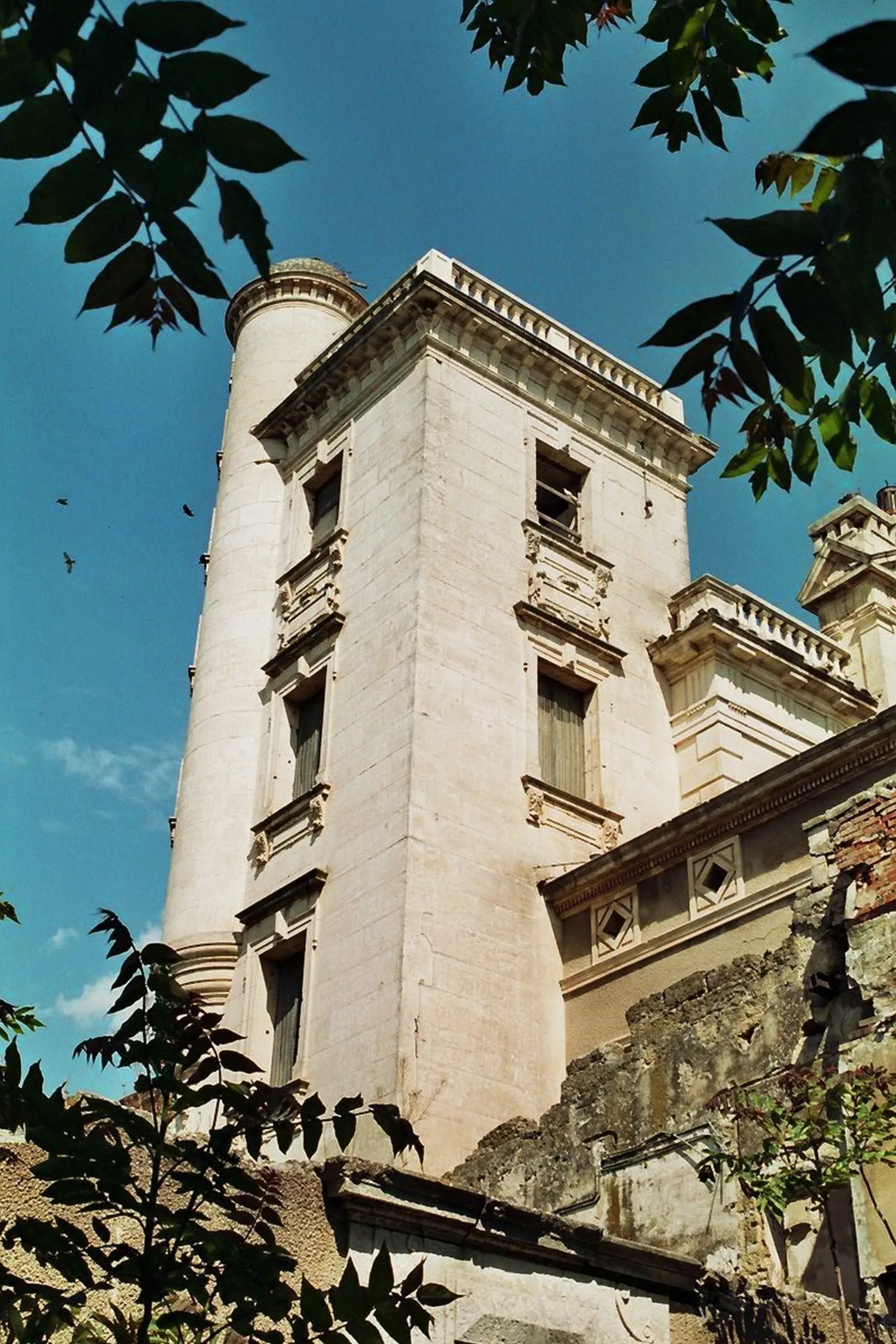
Urbex in Nimes is a special case: the Roman city is packed with living monuments - the arena, the Maison Carree, the Tour Magne - but very few abandoned sites at its core. The real urban exploration ground begins as soon as you move out, towards the Petite Camargue and the Gard Cevennes: wine-estate chateaux left in ruins, medieval fortified houses overrun by vegetation, feudal remains perched above their villages. On our map, hundreds of geolocated spots cover the Gard and the whole Occitanie region.
For this article we picked 3 places that are genuinely abandoned and still standing in 2026, each verified one by one: a 19th-century wine-estate chateau in the middle of the Camargue marshes, a medieval fortified house first recorded in 1243, and the remains of a castle that dominates its village. No demolished spots, no renovated site passed off as a ruin. Under each entry, an "Add to my map" button saves the GPS coordinates to your personal account, for free and with no credit card.
The queries urbex Nimes, Nimes urbex map, abandoned places Nimes, urbex spot Gard, urbex around Nimes and urban exploration Gard all point to the same reality: a wine-growing, aristocratic and medieval heritage that history set aside - wine crashes, dismantled estates, rural exodus - and that photographers, urbexers and historians are rediscovering today. This guide gives you each site's dated history, its legal status and its real dangers, before handing you its coordinates.
Free Nimes urbex: why Urbex Maps changes the game
Before the spots, a word on what makes this guide different. Most sites that talk about free urbex in Nimes put "free" in the title, then redirect you to a paid forum or a closed Telegram group - when they don't simply hide the places under fictitious names ("Chateau Paradis", "Domaine Sablons"...) that are impossible to locate. Here the promise is concrete: under each place, an "Add to my map" button sends the GPS coordinates to your personal account, with no subscription and no credit card.
Behind the map is a community of more than 40,000 explorers, active since 2021. Every coordinate is checked at least twice - by the contributor who submits it, then by a regional moderator who confirms the spot still exists and has not been walled up or demolished. That filtering is exactly what is missing elsewhere: around Nimes, half the "big spots" on commercial maps have actually been razed (the Grau-du-Roi sanatorium) or are being converted (the Aramon power plant). The places offered in this article are part of our verified catalogue; the rest of the thousands of French spots are unlocked through packs that fund the moderation and field verification.
One reminder before you set off: urbex is not illegal in itself, but entering private property without permission is trespassing (article 226-4 of the French Penal Code, up to one year in prison and a 15,000 euro fine). We document these places for their history; we never encourage breaking in. Helmet, torch, ankle boots and caution on the floors: the ruins below carry real collapse risks.
1. Chateau de Montcalm - the wine estate swallowed by the Camargue (Vauvert)

About thirty kilometres south of Nimes, lost in the marshes of the Petite Camargue, the Chateau de Montcalm is the archetypal forgotten wine estate. It was built in 1882 by Louis Prat, a Marseille industrialist of the Noilly-Prat family (vermouth and absinthe), at the heart of a 700-to-800-hectare estate reclaimed from sand and marsh. A grand bourgeois residence flanked by wine cellars, stables and servants' quarters, the chateau was the hunting lodge where Prat entertained the Marseille bourgeoisie.
After Louis Prat's death in 1932, the estate was dismantled. The chateau changed hands repeatedly, its valuable elements - sculptures, woodwork, stained glass - were dispersed, and the building was even used as a stone quarry. Wikipedia, the most up-to-date source, describes it as "currently in ruins", "abandoned" and "decaying". Don't confuse it with the neighbouring neo-Romanesque chapel (listed as a Historic Monument in 2005, stained glass by E. Didron, 1886), which is not the chateau and does enjoy protection.
One honest caveat, to be checked on site: a secondary source (petit-patrimoine.com) mentions a re-roofing by new owners in the 2010s, which could indicate a partial restoration under way. Before going, confirm the real state with a recent photo. It is private property: access is not authorised. Standard risks of an old, unmaintained building - unstable floors, falling stone, weakened roof structure - made worse by the site's total isolation in the marshes (signal, access, rising water).
Montcalm remains the most spectacular spot in the Nimes area: a whole bourgeois chateau frozen in a marsh landscape, a witness to the golden age of Camargue wine-growing.
2. Chateau de Saint-Victor-de-Malcap - the medieval fortified house returned to the vegetation

About fifty kilometres north of Nimes, in the Ceze-Cevennes area near Saint-Ambroix, the Chateau de Saint-Victor-de-Malcap is a medieval fortified house first recorded in 1243. The original building dates from the 10th-13th centuries, before being enlarged in the Renaissance: it is arranged around a square courtyard, flanked by two large round towers on its south facade, and backs onto the village church. It was here that Pierre de Castillon, lord of the place, received Louis XIII during the surrender of the Protestant stronghold of Saint-Ambroix.
Today its remains, overrun by vegetation, enjoy no protection as a Historic Monument. In April 2025 the local press (Ceze Cevennes News) still described it as a "little-documented" and "mysterious" chateau, with no upkeep or restoration, the town hall mentioning a tourist trail that has remained on paper. Gaping walls, architectural motifs eaten away by ivy: the place is a genuine medieval set returned to nature.
Careful not to confuse it: "Le Chateau" managed by SEMIGA in this village is an unrelated 1997 rental building, and the "chateau rental" or guesthouse ads around the commune refer to other, inhabited residences. The medieval chateau is indeed the ruin described here. Risks of an old ruin left to itself: loose stones, unstable ground, thick brush. To observe and photograph from its edges; you never force your way in.
3. Ruins of the Chateau d'Aigaliers - the beheaded keep above the village
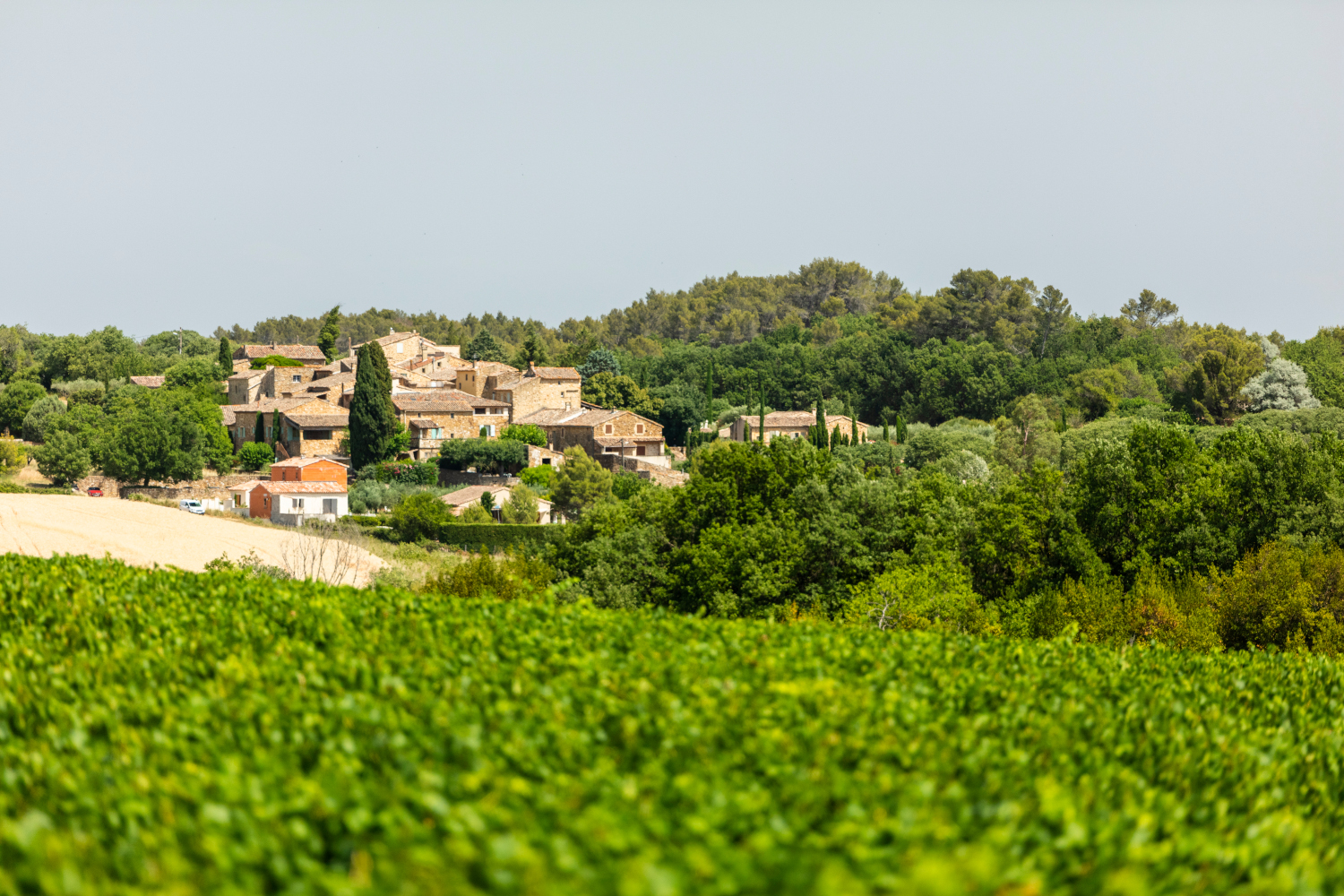
About thirty kilometres north-west of Nimes, the hilltop village of Aigaliers is dominated by the remains of its 13th-century feudal castle. All that survives is the trapezoidal curtain wall and the beheaded keep, together with the remnants of a bailey, curtain walls with watchturrets and traces of a drawbridge. Known locally as the "Castelas de Aquilerio", it is more a medieval relic than a classic abandoned building - but it is exactly the kind of place that justifies widening the radius.
Let's be transparent: when a city like Nimes does not have four or five genuine spots at its core, we widen the area rather than sell you renovated or invented sites. Aigaliers falls into this "we widen / relic" category: the ruin is stable, not converted, and freely accessible since it is part of a hilltop village. With no free-licensed photo of the keep available (Wikimedia Commons only documents the commune's church and temple), we illustrate this spot with a photo of the village and its ruins credited to the Gard tourism board, in all honesty.
The site is reached on foot from the village core, with no break-in since it is an open-air heritage relic. Take care at the edges: loose stones, unsecured drops, brush. It is an ideal extra stop after Uzes for anyone wanting to understand the medieval defensive architecture of the Gard. Find every spot in the area on the Gard map.
FAQ - Urbex Nimes
Is urbex legal in Nimes?
Urban exploration is not illegal in itself, but entering private property without permission is trespassing (article 226-4 of the French Penal Code). Most spots in the Nimes area are private: we document them for their history, without ever encouraging break-ins. For more, read our guide is urbex legal in France.
Why are there so few spots in Nimes itself?
Nimes is a museum-city whose major monuments (the arena, the Maison Carree) are maintained and open, not abandoned. The 60-kilometre radius around it is also poor in "solid" urbex: many famous spots have been demolished (the Grau-du-Roi sanatorium) or are being converted (the Aramon power plant, the Hotel-Dieu of Pont-Saint-Esprit). That is why we honestly widen out towards the Petite Camargue and the Cevennes rather than padding the list.
Where can I find other abandoned places around Nimes?
Our map lists spots across the Gard and neighbouring departments. You can add the three places in this article to your personal map for free via the button under each entry, then unlock the rest through our regional packs. To explore further west, see also our guide urbex in Montpellier.
Do I need special gear for these ruins?
For castle ruins like Montcalm or Saint-Victor, the essentials are a good pair of ankle boots, a helmet against falling stones, and caution on floors and loose walls. As the Chateau de Montcalm is isolated deep in the Camargue, bring water, a power bank and a way to find your bearings. Our urbex gear guide covers the essentials to start safely.
Conclusion: Nimes, an exploration that happens beyond the walls
From the Petite Camargue to the Gard Cevennes, Nimes urbex tells three stories: the swallowed golden age of a bourgeois wine chateau, the slow decay of a medieval fortified house, and the silhouette of a feudal keep above its village. Few spots, but real ones, chosen without inventing anything or passing off a renovated ruin. These places are open-air history books, fragile, to be explored with respect and without damage. Add them to your map, and carry on your exploration with our guide urbex in Montpellier or the free urbex map.