Urbex in Lille is a paradox. The metropolis was one of Europe's great industrial capitals - Roubaix, the "French Manchester", the forts ringing Lille, the spinning mills of the Lys valley - and yet, in 2026, many of the most-cited spots are decoys: Loos prison was demolished in 2016-2017, the Fives-Cail-Babcock works has been turned into an eco-district, the Hotel Florin was razed. On our map, hundreds of geolocated spots cover the Nord and the whole Hauts-de-France region.
We play it straight: central Lille does not have five genuine explorable ruins. So we widened the radius to the Nord department and picked 3 places that are genuinely abandoned and still standing in 2026, each verified one by one: a former flax dryer listed as a Historic Monument on the banks of the Lys, a Roubaix textile wasteland, and an abandoned power building. No demolished spots, no reconverted site passed off as a ruin. Under each entry, an "Add to my map" button saves the GPS coordinates to your personal account, for free and with no credit card.
The queries urbex Lille, Lille urbex map, abandoned places Lille, urbex spot Lille, urbex around Lille and urban exploration Nord all point to the same reality: a textile and military heritage that history set aside - the collapse of the linen industry, the deindustrialisation of Roubaix-Tourcoing, the decommissioning of the forts - and that photographers, urbexers and historians are rediscovering today. This guide gives you each site's dated history, its legal status and its real dangers, before handing you its coordinates.
Free Lille urbex: why Urbex Maps changes the game
Before the spots, a word on what makes this guide different. Most sites that talk about free urbex in Lille put "free" in the title, then redirect you to a paid forum or a closed Telegram group - and often list places that no longer exist. Here the promise is concrete: under each place, an "Add to my map" button sends the GPS coordinates to your personal account, with no subscription and no credit card.
Behind the map is a community of more than 40,000 explorers, active since 2021. Every coordinate is checked at least twice - by the contributor who submits it, then by a regional moderator who confirms the spot still exists and has not been walled up or demolished. That is exactly what the Lille scene lacks, saturated as it is with ghost spots. The places offered in this article are part of that catalogue; the rest of the thousands of French spots are unlocked through packs that fund the moderation and field verification.
One reminder before you set off: urbex is not illegal in itself, but entering private property without permission is trespassing (article 226-4 of the French Penal Code, up to one year in prison and a 15,000 euro fine). We document these places for their history; we never encourage breaking in. Helmet, torch, ankle boots and caution on the floors: the textile wastelands of the Nord carry very real collapse and asbestos risks.
1. The Lys flax dryer - the linen ruin of Erquinghem

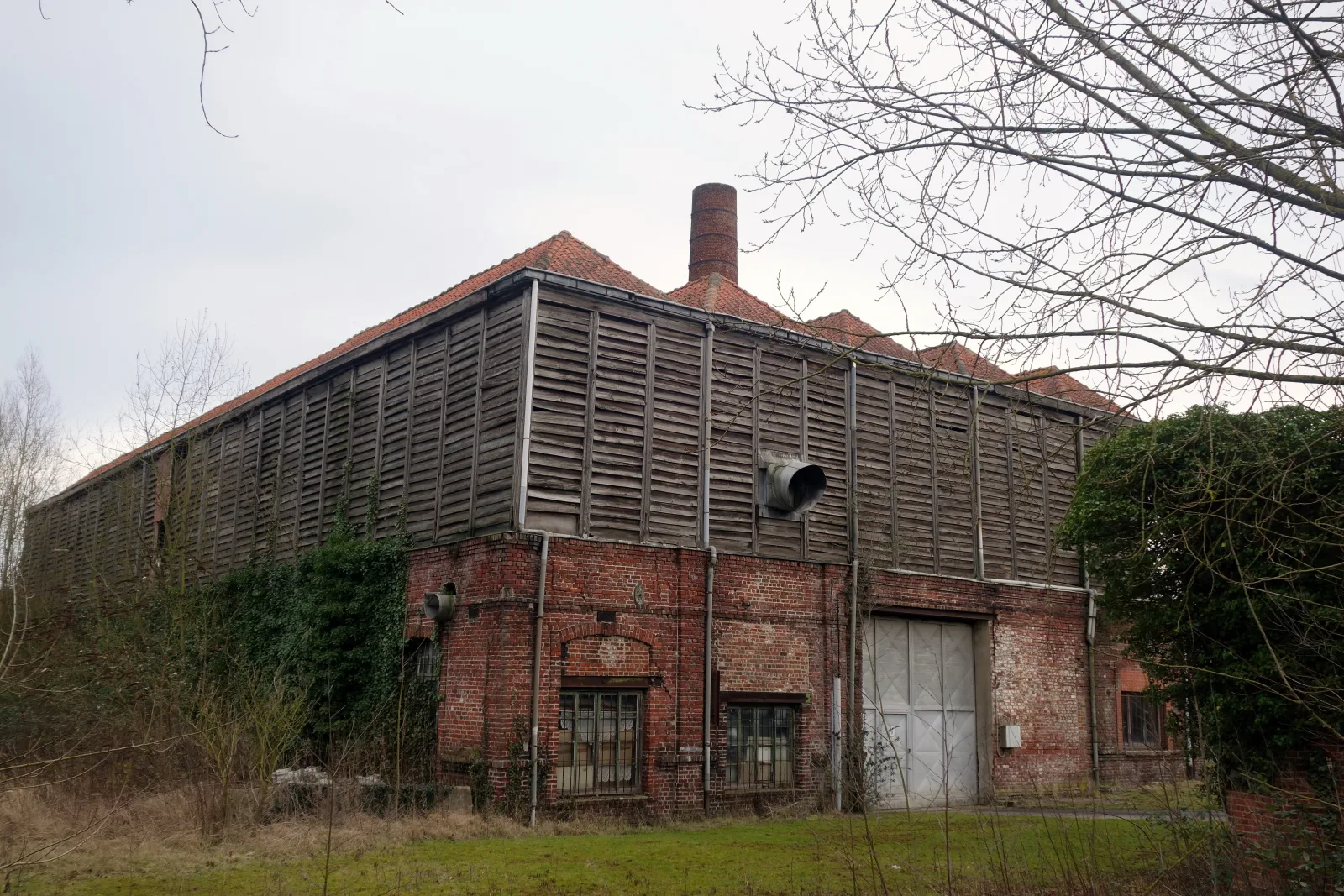
About fifteen kilometres west of Lille, on the banks of the Lys, the former Mahieu bleaching works is a relic of the golden age of flax. Built in 1892 by industrialist Auguste Mahieu, the "Blanchisserie de la Lys" bleached and finished linen yarn and cloth. Damaged during the First World War, it resumed in the 1920s, then closed in 1955. The site later passed to the moped maker Superia, then served as a warehouse for the Ramery company. Its flax dryer - a fire-heated hall topped with hipped roofs - was listed as a Historic Monument on 21 April 2000. Source: the French Ministry of Culture's Merimee database.
The dryer, largely collapsed since 2023, still shows its timber frame, brick walls eaten by ivy and the skeleton of its roofs. It is the archetypal linen wasteland of the Nord: nature reclaiming an industrial building that nobody has restored. For context, the Hauts-de-France heritage inventory documents the whole Mahieu empire, once one of the great linen dynasties between France and Belgium.
The site is private property: access is not authorised. It is above all a spot to observe and photograph from the outside, especially as the collapsed hall makes the interior dangerous (unstable frame, falling bricks, cluttered floors). About twenty minutes by car from central Lille, via the D945 towards Armentieres, rue des Freres-Mahieu.
This flax dryer remains the most authentic industrial relic of the Lille ring: the best entry point to understand the history of linen in the Lys valley.
2. La Lainiere de Roubaix - the Prouvost combing-mill wasteland (Wattrelos)
On the edge of Roubaix, nicknamed the "French Manchester", stood the Amedee Prouvost combing mill, known as La Lainiere de Roubaix: a colossal 33-hectare textile complex straddling Roubaix and Wattrelos, closed in 2000. Largely redeveloped since (the Union eco-district), the site still keeps abandoned buildings that have become a classic of urbex in Roubaix: weathered brick walls, obsolete machines coated in dust and rust, and the striking contrast between the industrial architecture and the vegetation creeping in. Roubaix concentrates much of the "abandoned places Lille" searches precisely because of this legacy: the city lost its industrial fabric but kept its walls.
Private property: the interior is not accessible without permission. The Roubaix textile wastelands combine every danger of an abandoned industrial building: sagging timber floors, broken glass roofs, and above all asbestos, common in the roofs and boiler-room lagging. An FFP3 mask, ankle boots and a torch are essential. The neighbourhood is still densely built-up: discretion and respect for residents are a must.
This wasteland is the most typical face of Lille urbex: a frozen working-class memory, to see before property pressure catches up with it as it has with so many other mills in the area.
3. The old power building - the brick giant of Roubaix
Still in Roubaix, along the canal, stands an abandoned former power building, a relic of the time when the city ran on the energy of its industry. Cracked walls, broken windows, facades covered in graffiti and vegetation: the place has become a landmark for fans of urban exploration in the Nord. Like many wastelands of the Lys valley and the Roubaix canal, it bears witness to an industrial heritage left without use after the deindustrialisation of the 1980s-2000s.
The building is fenced off and privately owned: access is not authorised, and it is more a spot to photograph from public space, along the canal, than a place to enter. Standard risks of an abandoned industrial structure: unstable slabs, leftover electrical fittings, and possible asbestos. About ten minutes from central Roubaix, reachable via the metropolitan transport network.
Together with the textile wasteland, this building forms Roubaix's industrial diptych: two fragments of a working-class past that the city has decided neither to raze nor to restore.
Around Lille: disused forts and vanished icons
Lille is ringed by Sere de Rivieres forts built after 1870. Most are now active military sites, turned into monuments or run by associations. The Fort d'Englos (or Fort Pierquin), in Ennetieres-en-Weppes, is one of the most interesting: built from 1879 to 1886, decommissioned in 1962, bought by the municipality in 1996, it is disused and largely reclaimed by nature. The Friends of Fort Pierquin association opens it a few days a year (Heritage Days, open days): so it is a fort to discover in a legal, supervised setting, not by trespassing.
As for wastelands on borrowed time, the former Terken brewery in Roubaix, liquidated in 2004, was long an urbex classic before entering a vast reconversion project (housing, a school, a restaurant), with works starting in 2026 - which means it is leaving the world of exploration. And some icons have simply vanished: Loos prison, a panopticon closed in 2009, was demolished in 2016-2017. If you still find these places listed as "active urbex spots" elsewhere, that is the sign of a map that has not been verified.
FAQ - Urbex Lille
Is urbex legal in Lille?
Urban exploration is not illegal in itself, but entering private property without permission is trespassing (article 226-4 of the French Penal Code). Almost all the wastelands of the Nord are private: we document them for their history, without ever encouraging break-ins. For more, read our guide is urbex legal in France.
Why are there so few urbex spots in central Lille?
Because the metropolis has restored a lot of its industrial heritage: Fives-Cail became an eco-district, Motte-Bossut now houses the national archives of the working world, Loos prison was demolished. The genuine abandoned wastelands are now mainly in Roubaix, Tourcoing and the Lys valley. Our map lists these spots across the Nord.
What gear do I need to explore a Nord textile wasteland?
An FFP3 mask is strongly recommended: asbestos is common in the roofs and boiler rooms of old textile mills. Add a head torch, a helmet and ankle boots for the sagging timber floors. Our urbex gear guide covers the essentials to start safely.
Where can I find other abandoned places around Lille?
Our map lists spots across the Nord and the Hauts-de-France region (the former coal basin, Pas-de-Calais, the Lys valley). You can add the three places in this article to your personal map for free via the button under each entry, then unlock the rest through our regional packs.
Conclusion: Lille, an industrial memory to explore with clear eyes
From the Lys valley to the wastelands of Roubaix, Lille urbex tells the rise and fall of a textile empire, and the decommissioning of a belt of forts. But it is also a field riddled with decoys: demolitions, reconversions, managed sites. Our stance is honesty - we will not sell you a ruin that no longer exists. These places are not stage sets: they are open-air history books, fragile, to be explored with respect and without damage. Add them to your map, and carry on your exploration with our top 10 abandoned places in Auvergne or the free urbex map.